Building a Future Ready OEM Program
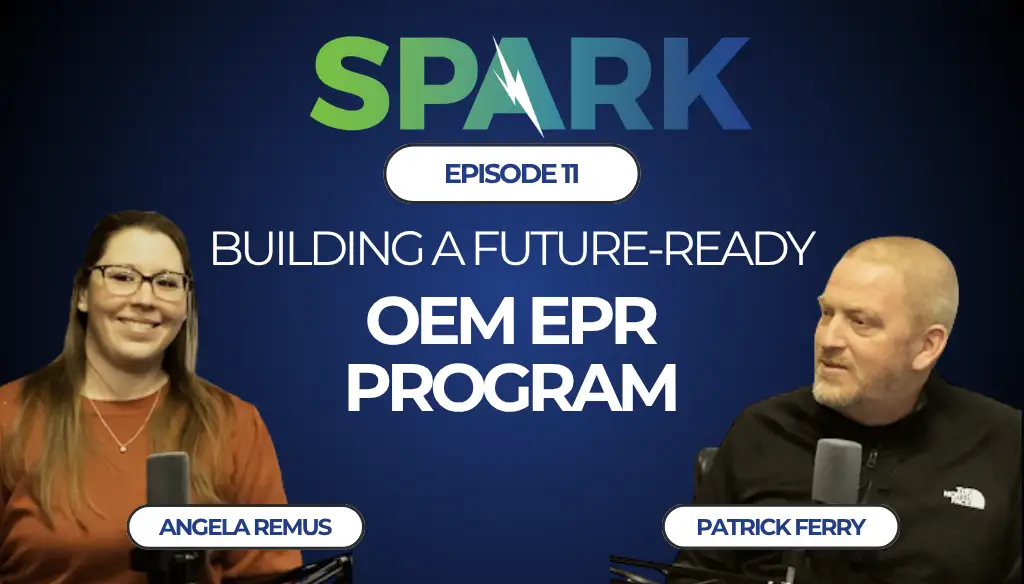
In this episode of the Dynamic Spark Podcast, host Caitlin Fiersted is joined by Patrick Ferry, Senior Global OEM Sales Executive, and Angela Remus, OEM Solutions Manager, to break down what truly defines a high-performing EPR program—and why it’s far more than a compliance checkbox.
Together, they explore the complexity behind EPR, from managing multi-state regulations to building the right partner ecosystem, and how OEMs can shift from reactive compliance to a more strategic, future-ready approach.
Key takeaways from this episode:
- EPR programs are complex ecosystems—not just reporting requirements—and require coordination across collection, compliance, and downstream partners
- The right partner should act as an extension of your team, providing proactive communication, accurate data, and regulatory guidance
- Vertically integrated partners can offer stronger outcomes by combining compliance expertise with operational insight
- “Legislative intelligence” is critical—EPR laws are constantly evolving, and staying ahead prevents costly risk and disruption
- Future-ready programs go beyond compliance to support ESG reporting, scalability, and long-term brand protection
Featuring guest experts Angela Remus and Patrick Ferry from Dynamic Lifecycle Innovations
View Full Podcast Transcript
Hi, and welcome to the Dynamic Spark podcast, where we break down what happens with your old tech and what this means for you. I’m your host for today, Caitlin Fiersted, and this episode, we’re gonna be diving into extended producer responsibility, or more commonly known as EPR programs. This is where we’re going to be defining what high performing EPR programs actually look like and why that distinction truly matters. I’m super excited to be joined today by Patrick Ferry. Patrick is a senior global OEM sales executive and you have over 14 years of experience supporting OEMs and building out their global EPR program. So welcome Patrick. Thank you for coming on today. you so much for having me, Caitlin. Appreciate it. And Angela Remus. Angela, you are the OEM solutions manager and you have a wealth of knowledge and experience in EPR, in compliance, in management systems, operations and ESG. So thank you so much for coming on today as well. Thanks, Caitlin.
For this episode, if you’re tuning in and you’re an OEM leader responsible for EPR compliance, this conversation is absolutely for you. So we’re excited to get started and hope everybody learns a lot. So getting into our first question here and kind of opening up to what EPR really is, can you talk a little bit about high performing EPR programs? What does that actually mean? Yeah, I’ll take that one, Caitlin.
So when people talk about EPR programs, they often think of it as just like another compliance box to check. But in reality, that’s not really the case. ⁓ It’s much more than that. It’s really a highly complex collection and recycling ecosystem that requires a lot of coordination, visibility, and accountability across a lot of different moving parts.
Some of those parts include collection infrastructure. So this could be as simple as a mail back program or as complex as a convenience requirement state where the number of collection sites are based on either population or geographic location. ⁓ There’s accurate obligation tracking. So states that assign manufacturer recycling targets. ⁓ And if you don’t meet those targets, some states can even have financial penalties with that.
It’s about registration and reporting deadlines. So every state requires at least something. And if you’re a manufacturer obligated nationwide, you could have up to hundreds of different reports and registrations and deadlines that you’re trying to keep track of. And it’s also about maintaining compliance as the materials move through each part of this ecosystem. And it really starts with safe collection. So batteries are up and coming ⁓ as like high risk more and more these days. ⁓ So are the collectors set up good best practices for mitigating those risks? Are your processors using the most up to date and newest technologies out there? Are they able to capture the most value out of the materials that they’re processing? And then it also includes downstream due diligence.
So are the products going to where your partners actually say they’re going and making sure that there are compliance checks and balances to ensure all of these different pieces are happening together. So really a high performing EPR program is designed to eliminate all of these risks before they ever even materialize. So it’s about taking away from a reactive burden into a more controlled and reliable system because really the costs of not meeting any of these are a lot more than just fines. It’s really reputational exposure. Yeah, wow. There’s so much packed into what you just said. mean, thinking about everything from all the different state laws, all the hundreds of reports, all the compliance, you said at the beginning, it’s not just checking a box and you can feel that as you’re describing what is all involved in those EPR programs to just make them successful. You know, ideally more than successful, you want them to excel in each of the programs to support what the OEMs are going out there and doing.
So thank you for going over that. That’s just a great introduction of what is all included in that. ⁓ And hearing so much about that, one question that I had was around the partnerships between OEMs and then their EPR program partners. So can you maybe describe a little bit about those nuances and how important it is potentially to partner with or have a partnership with somebody who understands all those nuances?
Yeah, that’s exactly right. Because there is a really big difference between knowing the rules and understanding how they are actually applied in practice. ⁓ High performing programs, it’s got to be more than just reading statutes. ⁓ You need programs and partners that stay closely aligned with ⁓ the agency guidance and evolving interpretations. ⁓ And there’s a lot of gray areas that inevitably come up. For example, ⁓ California recently passed an amendment where they added ⁓ covered battery embedded products. Now they define that what that means in the law, but it’s really up to the producers of these products to determine whether or not their products meet that definition and whether or not they’re obligated in that state. So I actually just had a client where we actually read through the legislation and the different tools and guidances out there to determine if her products were covered and we actually were able to figure out that her product wasn’t covered under the law, which actually saves her time, money, and reduces her compliance burden. So it’s questions like these, where you really want a partner that can translate what the specific EPR requirement is into clear, actionable guidance for you that you can confidently execute against. Yeah, sure. No, that’s wonderful.
Thanks for walking through that too, because sometimes I hear different aspects of what can impact the EPR program. But hearing those examples to know what people are actually walking through, that’s really helpful of just the impact having a strong partner can make. So that’s wonderful. Thank you. Thinking about different partners too, because there’s recyclers, there’s other types of partners, but I’m not 100 % on them. So I’d love it if you’re able to describe a little bit more about what those different types of partners are to support OEMs with their EPR programs. Absolutely, Caitlin. I can take that.
Really, you have a majority of people that all the stakeholders that are involved here are in the recycling industry and we all have a little skin in the game here, right? So you have your smaller regional recyclers that might be able to recycle X amount of weight, but might not be very up to date on compliance and up to all the regulations and all the requirements that we have in this industry. And then you have your semi-national recyclers that can produce and that can come through on volume in certain states but might not be at a compliance level of like a management company. ⁓ Next you have management companies that aren’t technically recyclers, but they are technically known in the industry as really being world-class in compliance. And then you have companies that kind of go above and beyond all of those, which is they’re vertically integrated companies, right? They have in-house compliance, they are actually recyclers, and they really know the nuances in the day-to-day of the operations of what it actually takes to come through for the manufacturers and their obligations.
- That was really helpful. Thank you for walking through that of just the different types of partners that OEMs can partner with. Follow up on that, though. when an OEM, because there’s lots of different sizes and types of OEMs out there, for an OEM, what types of partners would you recommend that they work with? Is it more that they should have a recycler and a management? Is it vertically integrated? Is it multiple? Is it one? What kind of recommendations would you give on that?
Well, I’d say it might help to outline some of the benefits of a vertically integrated company. I think Patrick and I will both say that vertical integrated companies are probably the best solution because they’re combining the compliance of a management company with the operations of a recycling company. ⁓ So when you put those two together, you get the best outcomes because a recycler is going to be able to anticipate changes in the market a lot sooner and be able to interpret those changes into how that relates to compliance and the state legislation and be able to proactively communicate when things need to change or stuff is shifting around. They just understand the landscape a lot better because you’re constantly in it. And if you’re a really good partner, you’re hopefully certified and then you’re also audited to the compliance requirements as well. But there’s also a difference in like the type of OEM too. Like we may recommend a vertically integrated partner, but it also depends on you as the manufacturer, what your needs are. Yeah. mean, a vertically integrated institution can really tailor their needs to the OEMs, right? So there’s a lot of smaller manufacturers that the main contact who’s running their e-waste legislation is probably also running their marketing department, is also running multiple departments. So their bandwidth and time is extremely valuable. So that’s where you really have to, you know, find a company that you obviously can trust and that’s going to come through on the compliance side, you know, provide fair market price, but really take off all of that responsibility off their shoulders and then put that on the actual management or, know, virtually integrated company. So that’s a really big positive impact to these companies too, because it’s a big time saver for them. Absolutely. I’d say if you’re a larger company, it’s less likely that you’re going to outsource the entirety of your program. You probably have a lot more time and resources out there. Also, it’s understandable that you would want to diversify your partners just as a risk mitigation strategy.
But I would say even regardless of the size of your company, I think it’s important to ask yourself these types of questions when you’re vetting out different partners and programs. So, you really want to know is your partner helping to elevate and simplify your EPR program? Are they bringing you new ideas and solutions and helping you customize the requirements to meet your specific needs? Are you getting accurate information when you want it? Or are you having to reach out for it? Do you have to contact them? Are you getting things late? ⁓ Is it accurate? Like, do you have to constantly pour over the data to make sure it’s right? Or do you feel confident and trusting in the numbers? Does your experience make you feel like you are their top priority? Are they returning your calls in a timely manner? Do they pick up when they answered? Are you having to follow up on emails?
And really at the end of the day, you should really have a partner that feels like an extension of your own company. Because really you just want to work with a partner that you actually like working with. You don’t want to have go into a meeting with your partner every time and think, oh, I have to talk to this person again. So find someone you trust and makes you feel important. Yeah, absolutely. And just to add a little bit to that, you know, just like what Angela said, it really doesn’t matter the size of the manufacturer. could be the biggest manufacturer in the world. It could be a new manufacturer that’s just getting into the market and starting to sell their products. I mean, really what these companies need to 100 % focus on is, is the company that they’re working with and trusting their brand with, are they 100 % dedicated to these long-term goals of the ecosystem of the manufacturer? That’s super important. mean, there’s so many nuances in each one of these laws, knowing every single covered device in each state, knowing the covered entities in each state. Knowing that you could put together a B2B deal in the state of New York and, you know, take TVs out of a business and still count that as program. There’s just a lot of very detailed nuances that really separate, you know, the best companies that support, that actually do this service versus kind of the fly-by-night ones that just sell weight. It’s really important. Yeah. Thank you for walking through all that. And just appreciate too all the details that you guys went into. I mean, the theme that I’m picking up on is one, the trust that you have with your partner. You’re an OEM, you want a partner that you can trust. You guys have talked about certifications. That’s really important. They have those certifications. It provides more of that trust. But also, so much of what you said leads to the partner being proactive with communication, with the responsibilities that they’re in charge of to help manage your EPR program. And I know, I mean, when you work with anybody, it is just fantastic and just a breath of fresh air.
When you know they’re being proactive and you don’t have to follow up with them, they’re giving that material to you. Whether it’s email communication, follow up on my questions, reports that I need, instead of having to ask for it and add more time to my day asking for it, actively having somebody send it to me before I have to ask for it is just fantastic. So that’s wonderful. Absolutely. And you don’t want their world to be more complex. You want to make it as simple as possible. And Angela hit the nail on the head. You actually want to work with people that you like. ⁓ You know, that’s actually a key to the actual business relationship. Are you going to get a phone call, California time, at 6 o’clock at night, say 8 o’clock Central Standard? Answer the phone. I mean, it’s your client. So really, at end of the day, I think those are really important details on just making the relationship very strong.
Yeah, those small things make a difference. Yeah, absolutely. OK, you guys hit on a lot of that. Is there anything else you would add in terms of what makes a partner a top tier partner then?
Yeah, absolutely. Just really being able to add in real world applications into the overall business relationship and understanding that the partner that you’re hiring and that you trust has to be very intimately involved with all the stakeholders. That’s from the collection sites to the state agencies to the other recyclers that you’re working with. It’s really a solid ecosystem of trust and responsibility. Again, this is a, you know, it’s not the most serious thing in the world, but manufacturers can get fined. People can get fined for doing things that aren’t right. If you don’t hit a quota in a certain state, a state agency could technically have you not sell your brand in that state. So the implications are pretty serious. So you really have to be able to build that trust and trust somebody that’s going to be working with you on that. Yeah, I would add to like the ability to scale with the company. So you want to make sure that your program partners are future ready. You wanna have a partner that has integrated systems that can handle new regulations, new technologies, new devices. You don’t want to have to constantly be reworking your program. You wanna find a partner that can grow and scale with you as the landscape shifts and changes. Because more and more EPR is becoming closely tied with things like circular economy, ESG and sustainability, brand protection, data security, and along with ESG, above and beyond that is environmental accountability. like sustainability reporting and those types of things. If your program isn’t already capturing those types of things, in addition to the state registrations and reporting, you’re maybe already behind the curve because the best programs out there are doing these both in tandem right now.
Yes, I love your future ready comment as well too because it’s really closing the loop on the full circularity of this world, right? I mean the manufacturers are making their products, you know, the recyclers are tearing their products down, putting the commodities back into new products and being able to track ESG, carbon emission, it’s, I mean, just like what Angela said, if you’re not currently doing that right now, you’re two steps behind. So it’s really the, you know, the future of the services that you can offer manufacturers and how we can partner.
Yeah, and I’ll expand on reporting too because there are so many different parts reports ⁓ and some of them are very easy and simple, but some of them are really complex. ⁓ The states of New York and New Jersey, they require all stakeholders of the process to report. So the collectors report, the recyclers report, the manufacturers report, and all of these reports are reviewed and scrutinized by the government agencies to ensure accuracy and call out discrepancies. So you wanna make sure that your partner is giving you the right information and is coordinating all of that stuff behind the scenes so that you, when you submit your report, you feel confident in it. And if there is questions that arise, you want a partner that answers those questions quickly, confidently, and resolves the issue without anything ever, without you ever having to do anything at all.
No, that’s awesome. I love the comments too. one, it’s having a partner that is just successful and it’s just you trust wholeheartedly. ⁓ But you mentioned future ready. And then in tandem with that, Angela, you had talked about, you know, not just the the standard reporting, but going above and beyond. Like when I work with a partner, I don’t want them to just do the bare minimum. I want them to do everything that I need now and will need into the future. So the way you describe that and just how that’s all related to each other, that was wonderful and just really appreciate the details that you added there. So thank you. ⁓ Is there anything that people might not be looking into that is really important? Like, what would you say is the biggest, I don’t want to say gap, but just oversight, right? Everybody’s busy. So what is that thing that people might be missing when they’re working on their EPR programs that you would recommend them to take a look at?
Yeah, definitely. One thing that comes to my mind is something I like to call legislative intelligence. A common misconception is that once a law is passed, it’s static and unchanging, but that’s not really true. ⁓ EPR regulations are evolving and laws are being updated and amended and clarified as the markets, technologies and policy priorities change around us.
So legislative intelligence really means actively monitoring those changes, interpreting what they mean in practice and translating them into proactive guidance. A really good example is the state of Oregon. So they passed an amendment to their law in 2023, but it didn’t become effective until 2026. So if you weren’t really tracking and monitoring that throughout the past three years, you’re probably a little behind the curve because the amendment really changed the entirety of the law. It went from a state run ⁓ managed program to a producer responsibility organization. So that shifted the ⁓ responsibility of the agencies that are controlling the program. It also added a lot of convenience requirements. So the collection infrastructure and number of collection sites out there were were updated. It added new products. So you’re bringing in new manufacturers and new products under the scope. So really, it’s almost an entirely different law by the time you take into account all of those different factors. So that’s why it’s not enough to simply understand what the law says today. You really need to know where it’s headed because without that forward-looking perspective, companies are left reacting to changes.
But with right partners, you were able to stay ahead of this curve and adapt with confidence instead of scrambling to catch up. Yeah, that’s crazy to think that, you know, a law that was passed in 2023 gets put into action or is, you know, in effect in 2026. So three years. But if you’re don’t have a strong partner, they missed out on a year or two of those years because they’re getting ready for 2026 and not ready for it in 2023. That’s a big difference.
Yeah. And as you mentioned through that example too with Oregon is it’s not just one part of the law that changed. There are multiple parts of that law that changed. Being up to date on all that is really important, I would imagine, but really valuable for an OEM if they have a partner who’s proactive with that and is up to date with that. One question off of that is when you’re working with so many different types of legislation and throughout just so many different states, how can OEMs or their partners for EPR programs be involved in voicing opinions or perspectives? Can you talk a little bit about that and that involvement?
Yeah, there are actually a lot of different ways that stakeholders can participate in the legislative process. So some examples include joining an advisory board, a committee, a technical working group. A lot of laws open up their changes for public comment. So you can always submit public comments. Many legislative hearings are public, so you can attend the hearing in person, or you could provide official testimony at one of those hearings to the regulatory agency. An example of how this could happen in practice is recently this last fall, the state of Minnesota has tried to amend their law a few times and hasn’t gotten through the legislative sessions. So they brought together all the different stakeholders under the law. So this included representation from manufacturers to retailers, recyclers, refurbishers and ITAD companies, collectors, household hazardous waste. And they brought all these different parties together to work through what should be in the law and what can the group come to as an agreement and consensus on as being the most important things that the law needs to achieve.
So that’s a really good example of like, ⁓ that one was managed by the state, but those other examples are usually open for, for more public. Wonderful. Have, have you guys ever been a part of any of those types of forums too? Is that something that you have actively participated in ever?
Yeah. I mean, we’ve publicly spoken multiple conferences and stakeholder meetings and, Angela and Amanda from our team are actively engaged in any kind of potential changes in legislation. So I think a true partner will be at that level of engagements. It’s super important. that’s really cool. Just the impact and level, the distance that you’re willing to go to for the partners and everything or for the OEMs that you partner with. So that’s fantastic. It’s cool to hear. Well, while DYNAMIC does participate in those, I think it’s important to note that we have, you know, we wear many different hats as a company, but regardless of who you are or which company you work for, for what your true advocacy is, it’s best to participate in those processes as an advocate for the best program. So you wanna make sure that you use your voice to advocate for outcomes that are gonna work for all stakeholders because the strongest EPR programs are the ones that don’t just look good on paper, they make sense in real world applications. So you wanna balance regulatory intent with actual operational feasibility so that you can ensure that these programs are effective and sustainable over the long time. ⁓ Any active stakeholder participation is going to be good because it leads to informed input and smarter policy, better implementation and ultimately just a stronger, more successful EPR program.
I appreciate you saying that too, just with, you know, having the involvement shows one that you’re active in the discussions at hand with legislation, but also just that you’re able to take that and then put it into action so much faster, probably, I would assume. And so thank you for touching on that. I just appreciate all the insights into legislation and just the, impact and how people can participate there. That was the last main thing that I had a question on is just around that legislation. But one question that I really enjoy asking everybody on the podcast is about advice. So if you were going to give advice to somebody who is currently managing an EPR program, what type of advice would you give them? Yeah, I can jump in there. I think really it’s, it’s really three pillars when it comes to the trust that you’re obviously going to be dealing with, you know, with some of these companies on a partnership. And I think one of the biggest ones is, you know, is your current process or partner adding value? I mean, are they adding value and helping you out? I think that’s extremely important. And are they able to scale with you? I mean, if you can’t grow and you have to go backwards, it’s a big problem for some of, I mean, some of these manufacturers are some of the largest companies in the world, right? So you have to be able to scale even on a small manufacturer that’s just getting into the market as well too. And you really need to you really need to focus on being able to work with one company with one You know one attitude of winning and really having that vertically integrated, you know system involved Where you don’t have to work with seven different companies and work with one company under one roof So I think those are extremely important when you’re trying to make a decision on who your vendor is gonna be and you know Who you’re gonna trust really at the end of the day? Yeah, I would say like ven though EPR and compliance isn’t really life or death, it can really feel that way sometimes. So my advice is to find a partner that takes it as seriously as you do so that when your stakeholders are asking you questions, you can respond with confidence because organizations that succeed won’t just have like a recycling partner, they’re gonna have a complete compliance infrastructure.
Absolutely. Thank you for that advice. I love that question because it just usually ties everything together, but also just like, is that the most important thing that you would kind of leave as a thumbprint on somebody after this? So appreciate that. No, so thank you. I think the strongest themes that I heard through everything that we’ve talked about today is one, that scalability, scalability. And you mentioned a couple of times, future ready. I love how you were using that term. So I’m going to steal that, but scalability and future ready, being able to utilize that as and those skill sets as an OEM with your partner, it’s fantastic. But then also touch on quite a bit that confidence and trust that you have with your partner is just key, right? You want that with everybody, but having that with a partner, especially when there’s so many important things on the line. You’ve talked about just with the reputation brand that’s on the line, but also financial costs potentially on the line as well. So you want somebody that you can trust and have confidence in that partnership. And then I think another thing that we heard about a lot is being proactive, right? You want a partner who is proactive with you, who’s proactive on what’s happening.
Meet The Speakers
Adam Burrett is theFounder and Managing Director at NovaFox. Connect with him on LinkedIn today.
Casey Dingfelder is the EVP of ITAD at Dynamic Lifecycle Innovations. Connect with him on LinkedIn today.
Rolly Aponte is a Senior Development Engineer at Dynamic Lifecycle Innovations. Connect with him on LinkedIn today.
Related Resources