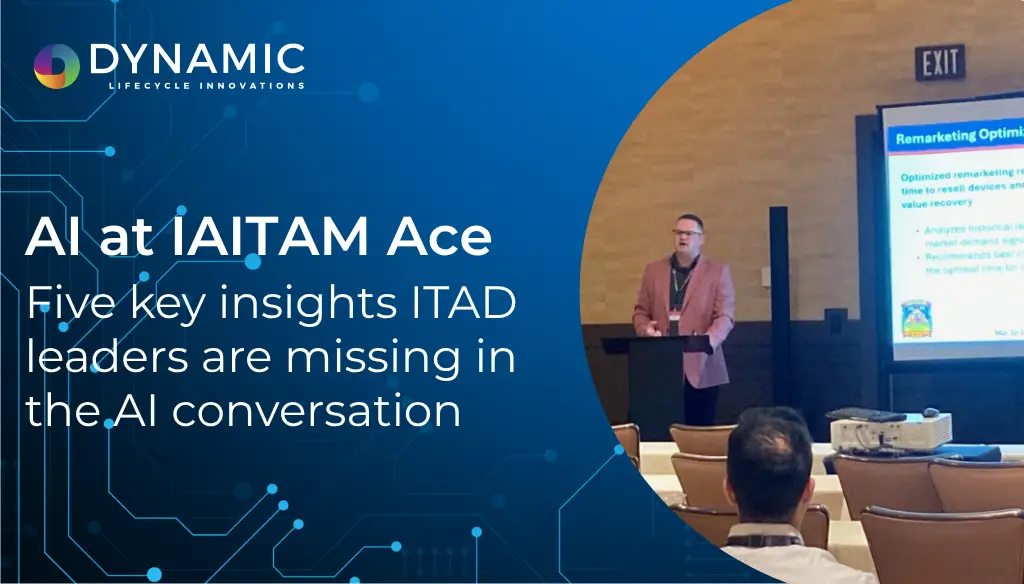
AI at IAITAM Ace: Five Key Insights for Industry Leaders on ITAD
The most common session at IAITAM ACE 2026 was AI.
As IT asset disposition (ITAD) and ITAM programs grow more complex, organizations are looking for ways to improve efficiency, reduce friction, and scale operations without sacrificing compliance, recovery value, or stakeholder trust.
Every session had it’s own unique ideas and insights. But among many of the conversations about AI-powered tools and automation gains, the human side of the equation was conspicuously absent.
In his session, How AI is Transforming ITAD Performance, Dynamic Lifecycle Innovations’ Conner Knerzer focused on the operational realities organizations are facing today and the need for human planning alongside automation.
Instead of asking, “How much AI can we add?” and putting an AI-powered sticker on a presentation, the session challenged attendees to ask better questions. Questions about results, guardrails, and when to use Artificial Intelligence vs Human Intelligence.
Here are five key takeaways for ITAM leaders from this session.
1. AI Should Support People, Not Replace Them
One of the strongest themes throughout the session was that AI works best as operational support, not operational authority.
AI can improve things that require rapid, quantitative response, such as:
- intake workflows
- grading consistency
- remarketing recommendations
- anomaly detection
- reporting speed
But human oversight is better in qualitative cases such as :
- edge cases
- compliance decisions
- governance
- stakeholder communication
- accountability
As Conner explained during the session:
“The goal isn’t, ‘Trust the robots.’ The goal is to design a process where AI does the heavy lifting, and humans continue to make the important decisions.”
That distinction matters in ITAD.
Because when Security questions chain-of-custody, Finance questions recovery swings, or ESG leaders need defensible reporting, organizations still want real people accountable for the outcome not a black-box system that nobody can explain.
2. Every AI Strategy Needs Lines in the Sand
One of the most practical ideas from the session was the need for clear operational guardrails before organizations rush into AI adoption.
Throughout the presentation, Conner challenged attendees to think critically about where automation belongs, can be effective, and where human oversight must remain non-negotiable.
In other words: before adopting AI, organizations need “lines in the sand.”
Those lines are:
- Never accept black box grading for high-stakes calls
- Never trust AI claims unless they’re backed by real metrics & baselines
- Never let human authority disappear at points of real risk
Each of these lines focuses on trusting & verifying the claims made by those who work with AI tools. This is especially important in ITAD where data security is paramount.
As Conner noted during the session:
“AI is not a free pass on governance.”
No matter how advanced automation becomes, organizations are still responsible for:
- data security
- chain of custody
- downstream compliance
- ESG reporting
- and stakeholder trust
The technology may evolve.
The responsibility does not. So creating lines in the sand over what AI can do is key to protecting your brand reputation.
3. The Best AI Programs Start Small
Another major takeaway from the session was that successful AI adoption rarely starts with massive transformation projects. Instead, the strongest programs approach AI like a controlled operational experiment. Each AI use case should be tied to a simple baseline and a few key metrics, so that efficacy and improvements can be clearly attributed.
Conner outlined a practical framework organizations can use when evaluating AI inside ITAD workflows.
Start with one narrow use case
Focus on a specific operational pain point such as:
- intake
- grading
- reconciliation
- logistics
- remarketing
Establish a measurable baseline
Before changing anything, define:
- cycle times
- recovery rates
- error rates
- throughput
- exception frequency

Instead of asking, “How much AI can we add?” and putting an AI-powered sticker on a presentation, the session challenged attendees to ask better questions
Keep humans in the loop
Automation should assist decision-making.
Human teams should continue handling:
- exceptions
- escalations
- approvals
- governance reviews
- stakeholder communication
Scale only after results are proven
The session emphasized disciplined rollout over hype-driven deployment.
As Conner described it:
“Pick one thing. Get that right. Then move to the next thing.”
The organizations seeing meaningful ROI from AI are not chasing the biggest implementation.
They’re building repeatable operational wins one workflow at a time.
4. Trust Is Becoming the Most Important Metric in ITAD
The biggest ITAD challenges today are no longer just operational, especially as ITAD gains focus from other teams within the enterprise.
Security teams want defensible chain of custody.
Finance wants predictable recovery.
ESG leaders want credible reporting.
Executives want transparency when risks appear.
The session emphasized that AI only creates value if it strengthens trust across those conversations.
One question surfaced repeatedly throughout the presentation:
“Can you actually trust the trail?”
That mindset applies to every AI conversation happening inside ITAD today.
In practice the real win for ITAM leaders is when those conversations with Security, Procurement, Finance, and ESG get clearer and easier, not just when dashboards look smarter.
Because faster automation means very little if stakeholders lose confidence in the process behind it.
5. The Future of ITAD Is Human + AI
The session closed with a practical reminder for ITAD leaders:
The organizations that succeed with AI will not necessarily have the flashiest tools.
They’ll be the organizations making:
- better decisions
- more consistent decisions
- more transparent decisions
- more defensible decisions
The winning formula is to use AI to enhance intelligence.
As AI continues reshaping ITAD and ITAM operations, the strongest programs will combine operational intelligence, measurable results, transparency, and real human accountability.
Because in the end, trust still comes from people.
As Conner concluded during the session:
“Treat AI as the muscle behind your ITAD program — but never let it replace the face and voice your stakeholders trust.”
At Dynamic Lifecycle Innovations, we believe AI should strengthen operational performance while keeping people, partnership, and accountability at the center of the process. To learn more, schedule a meeting with one of our ITAD solutions specialists at the link below.