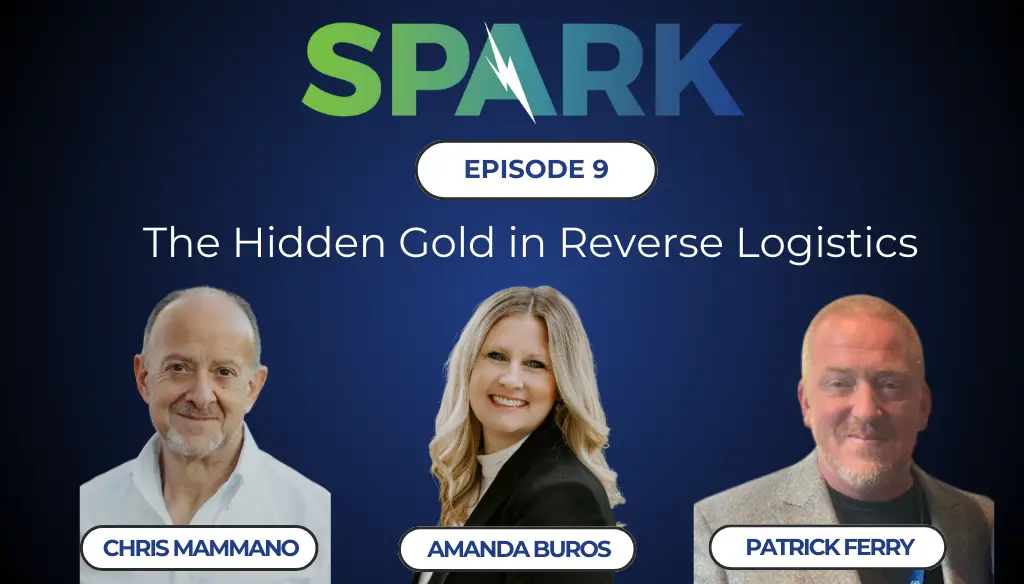
The Hidden Gold in Reverse Logistics
Reverse logistics is no longer a quiet, back-end function of the supply chain, it’s becoming a strategic lever for value recovery, brand protection, and circularity.
In this episode of the Spark Podcast, host Amanda Buros is joined by Chris Mammano and Patrick Ferry to explore why reverse logistics is having a moment and what that shift means for retailers, OEMs, and logistics providers alike. As return volumes rise and sustainability expectations grow, organizations are being challenged to rethink how they manage aging inventory, recover value, and reduce risk across the product lifecycle.
Together, they discuss how intentional reverse logistics programs can move beyond cost containment to unlock reuse opportunities, improve data visibility, and support more circular outcomes. The conversation also highlights common barriers organizations face, what’s changing in the market, and where leaders should focus as reverse logistics becomes a more visible part of supply chain strategy.
Whether you’re responsible for operations, supply chain strategy, or sustainability, this episode offers practical perspective on how reverse logistics is evolving — and why now is the time to take a closer look.
Featuring guest experts Patrick Ferry and Chris Mammano from Dynamic Lifecycle Innovations
View Full Podcast Transcript
Amanda Buros (00:00)
Welcome back to the Spark podcast, where we talk about the ideas shaping a more circular and resilient supply chain. Today, we’re digging into reverse logistics, a part of the supply chain that used to sit quietly in the background, but now it’s front and center. With online return rates creeping towards 30%, the cost of returns hitting hundreds of billions of dollars annually and a growing push to keep products out of landfills, companies are rethinking how they recover value and reduce waste. If you’re responsible for operations, supply chain strategy, or sustainability, this episode is definitely for you.
I’m joined by Chris Mamano and Patrick Ferry, who work every day with OEMs and logistic providers to simplify returns, reduce storage headaches and protect brands and create more value from equipment that’s reached or is nearing the end of its life. Let’s dive into what’s changing, why it matters and how you can start prepping now. So Reverse Logistics is having a real moment.
Returns are rising, storage space is getting tighter, customers expect more transparency, and sustainability pressure is growing. OEMs and logistics providers feel this, sometimes in very similar ways, but sometimes very differently. Chris, from the conversations you’re having, what’s driving the surge in attention around reverse logistics right now?
Chris Mammano (01:10)
So I think it’s a great question, Amanda. There’s a couple of parts to the answer, but I think primarily the answer is the need to differentiate, Suppliers, service providers in the market, and particularly logistics providers who are broadening their scope of services more and more, need to stay competitive and need to differentiate from the folks that they are competing with. So adding value-added solutions to what they’re already doing for these customers, and particularly large OEMs and manufacturers, makes all the sense in the world. This is going to help them retain and hopefully attract new business as well. I think, from the supplier side and the OEM’s position in this, they’re always looking to consolidate suppliers, I think the last two decades have represented a lot of large corporations seeking to leverage more spend with fewer people, manage fewer partners in the process, and that’s become a big piece. And then the last piece, I think, that’s driving the surge, and maybe this is hope on my part, but I do believe it is a reality, are the ESG benefits that come from proper and responsible reuse and recycling. The message has been out there. It’s getting louder, and it’s starting to get a lot better response, I’d say, than it has in the last several years.
Amanda Buros (02:27)
Excellent. And Patrick, what stands out to you from the OEM perspective? What’s pushing manufacturers to rethink their approach?
Patrick Ferry (02:35)
That’s a great question, Amanda. I think, really what it comes down to is, some of the biggest manufacturers in the world have a great opportunity right now to really show their green initiatives to their customers, to their clients, to pretty much everybody. And it really does circle back to, their brand recognition, brand value, making sure that they have a solid brand, that there’s a brand that they can, stay in behind and be proud of. So I think I think a lot of larger manufacturers right now are truly environmental stewards and they are doing their best with carbon emissions and with ESG reporting and data. So I definitely think we’re on the right track, but more work to come.
Amanda Buros (03:16)
Excellent. Chris, can you share a little bit more about what may have held OEMs or logistics partners back from launching return programs in the past?
Chris Mammano (03:23)
Yeah, another great question. I think what we hear the most particularly on the OEM side is they don’t want to compete with their sellers of new, So most of the mantras of the past and their process flows were to recycle and destroy everything at the end. While it’s certainly a viable path, it doesn’t bring all the benefits that it could if it mixed with ⁓ proper reuse. But I think that’s the most common pushback that we hear. A lot of good reasons to talk that through with the customer because I think most to the Tier 1 OEMs have realized that they’re not necessarily competing. It’s a different market that’s consuming the secondary use.
Amanda Buros (04:06)
Yeah, that’s great. know we’ve done a lot of conversations kind of sharing that added value. And I think on our side, Patrick, too, is we have some conversations about just circular economy and helping getting critical materials back into flows. There’s a lot that goes into unpacking the different stages of reverse logistics and where we can find value along the chain. So let’s break down what reverse logistics really includes and how the opportunity differs for OEMs and logistics providers. Patrick, let’s start with OEMs. If a manufacturer still sees reverse logistics as just a necessary cost, how would you reframe the full potential that it holds today?
Patrick Ferry (04:46)
That’s a great question, Amanda. think right now it’s really ownership and chain of custody with your product. once the once the materials are sold, either at retail or whatever sales platform it is, they can really go anywhere. think a lot of the larger manufacturers right now are providing, free to consumer, free to B2B take back programs, whether that’s, physical take back, mail back to be a lot of different programs. Some of them are brand specific. Others are just normal consumer brands right now. And really getting those back to certified electronics recyclers or refurbishment companies. And I think some of the ones that are really ahead of the curve right now are taking and utilizing refurbishment and reuse that can offset to properly pay for the certified recycling. And it can also get some of their components that are down to the commodity level back into new products. So I think there’s a turn right now in the industry where people are trying to do the right thing. And I think people are getting a little smarter, too.
Amanda Buros (05:51)
Great. Chris, logistics providers have a different vantage point. They’re already holding return gear, processing shipments and dealing with storage overflow. What opportunities are they uncovering when they lean into reverse logistics instead of treating it as an afterthought?
Chris Mammano (06:05)
So I think if they lead with this as a service and a value add to their customers, they’ve got an advantage over what the current state might be. Like you mentioned, Amanda, they’re already holding onto the product. Fewer hands need to touch the products if they are indeed the ones who can provide the ultimate solution. Not only are they already holding the product, they’re already being directed by their customers at some point to offload that and send it to some third party for whatever its end of life is going to be according to that customer of theirs. If they come to the table and they say, hey, we already have this, it’s risk gets greater when it changes hands, So the fewer hands that could touch this, why don’t we, as your logistic solution provider, put a schedule and a plan together? Why don’t we say after X amount of days, weeks, months, this type of inventory will be offloaded and why don’t we consider the reuse portion of this working with their certified partner to be able to provide those services, right? I think it showed a lot of vision on the part of some logistics providers a year or two ago when we started having these conversations. Now I will say we go to the logistics shows and you will see a lot of folks offering electronics recycling, but clearly these are new and I would say in many cases not fully developed offerings.
Amanda Buros (07:32)
So we’ve talked a little bit about some of the benefits, but for logistics providers that are sitting on shelves of returned or aging equipment, what’s the cost or the risk of that doing nothing?
Chris Mammano (07:42)
So there’s a lot of risk in doing nothing, right? In terms of the value of the equipment, if the customer understands the sustainability initiatives and the benefits that come from proper reuse, they want to get those products out into the market because the longer they sit on the shelf, two things happen. One, they’re incurring storage fees, which again, great vision from the reverse logistics providers to say, hey, we’re going to give up some revenue stream here where we’re charging our customers to store things for months and maybe in some cases years. But we’re going to offset that by the benefit that they will see from the resale portion of this, the proper recycling and whatever they may charge for the services associated with it. But the customer, the end user, they’re now not paying for that storage. The sooner we move it, in all likelihood, the higher the value it’s going to have. The overwhelming majority of the time equipment devalues over time as it sits on shelves. Makes sense, particularly in the technology space, but there’s a lot of risk in having it sit there because at the end of the day it may not be viable if it sits too long.
Amanda Buros (08:51)
Yeah, I think that’s a great point that there’s even bigger risk with doing nothing. So let’s make this real. When reverse logistics systems are built intentionally, they can reduce costs, improve customer experience, open up resale opportunities and strengthen sustainability reporting. Chris, can you share an example where a company really nailed their reverse logistics system? What changed and what happened as a result of that?
Chris Mammano (09:15)
Yeah, it’s the company I referenced before that had vision, ⁓ Large global logistics provider working with many, many large manufacturers and particularly tier ones in the OEM space. Like I had described before, they had direction from the customer from time to time, not necessarily in a programmatic scheduled basis. Hey, take these truckloads of equipment that came from this stream of returns and send it to be recycled. They saw this as a real business opportunity, a chance to bring something to the table that their competition may not be offering in a full fashion today, but also help the customer with those storage fees, with the consolidation of vendors. And they had the vision to partner with a highly certified, highly capable organization like Dynamic, but it also resulted in a much more strategic discussion with their customer. We found out from them and their customer the reason they were recycling everything in the past is they were not necessarily pleased in a scenario they had tried a few years ago for resale with what the return dollars were. We were able to engage with that OEM’s sustainability team who had some excellent ideas about how to add value to the reused device and bring more dollars back to the organization. So it became a real collaborative response between the logistics provider, their sustainability with the customer of theirs and then our teams and what we could do for them.
Amanda Buros (10:44)
Yeah, that’s excellent. Patrick, how about you? What’s a real world story that shows the impact a smarter system can have, especially for an OEM customer?
Patrick Ferry (10:54)
I think certain certain OEMs are going above and beyond right now on sustainability goals. think good examples, multiple computer manufacturers right now, I think are really ahead of the game, ahead of the curve when it comes to their specific product being taken back, having to be free for the consumer, having to be convenient for the consumer. That’s that’s super important — taking their components to a certified electronic recycler or refurbishment company. Those companies properly managing certain commodities like I mentioned before, putting certain commodities back into new products. mean, that’s really full circle circularity. So I think that right now, there are certain steps that other manufacturers I think are considering taking. They might just be a little bit afraid of the upfront investment. Definitely, it’s not a free program, so there is a cost to it. But on the other side, the benefit of that cost is really your consumer and customer base. You can get more customers from really showing your green initiatives, really being that go-to OEM or product that people want to buy. And I think once people rally behind the product and the vision of the company, think that really does accelerate sales and also gives a great recycling opportunity on the back end for consumers and businesses to recycle those products properly.
Amanda Buros (12:18)
Thank you. Great insight. So Chris, when you look at companies getting this right, what’s the common denominator? Leadership buy-in, better data, the right partner, what tends to make the difference?
Chris Mammano (12:29)
Well, certainly the right partner helps and having the capabilities. But I would say the biggest thing is for the logistics suppliers out there in the market to have that kind of relationship with their customer to create a collaborative strategic discussion not just about protecting their existing business and going over quarterly reviews, but bringing to the table solutions that would benefit the customer that they should consider. And if they’re doing it elsewhere, why are they doing it elsewhere? You what were the decisions that went into that? Can we talk about that? I think it’s easy when you have those kind of relationships. It’s very difficult when you don’t, because you will find people in an organization that care, but maybe have no authority to do anything about it. Leadership is really key to get anything like this move through as an initiative and a standard moving forward.
Amanda Buros (13:20)
Yeah, absolutely agree with that. Patrick, what do you see when we look at companies that are getting this right? What makes the difference for them?
Patrick Ferry (13:28)
You know, I think Chris did a great job reiterating, strong business relationships, strong partnerships. I mean, it’s a collaboration, to be honest with you, between, your service provider and the company. But again, I think the brands and the OEMs that are doing it right are being extremely proactive on their brand reputation and the chain of custody of their material. I think that’s probably one of the most important parts, but that part doesn’t come together without strong business relationships and collaboration between service providers on how to
Amanda Buros (14:00)
Yeah, great point. I think we all know reverse logistics can be messy and expensive, but companies that get a hold of it, they are finding that they’re able to unlock real financial and reputational benefits. So you just started talking about this. What’s one example of a company that’s turned a return challenge into a real business advantage? Can you give us an example?
Patrick Ferry (14:19)
Yeah, yeah, absolutely. I don’t want to, sound like a broken record, but I really think that some computer manufacturers are really doing it right. And they’re just well above other companies right now. This is not electronic companies too. It could be shoe companies. It could be textile companies. There’s so many take back programs that we have right now that aren’t just solely focused on electronics. Free and convenient collection is where it’s really at right now. mean, just being able to offer that to your customers and your clients, I think that really sets you apart. And then being able to really stand behind your decisions that you’re making as a company. mean, it’s extremely important. Your customers are watching and they care. So I think everybody does a little different, but I definitely see that probably in the next five to 10 years, this should be the norm of what’s going on with larger manufacturers of any kind of product right
Amanda Buros (15:18)
Thank you. Chris, what’s an example where a smarter reverse logistics strategy helped strengthen a company’s sustainability position or maybe even reduced costs for them?
Chris Mammano (15:28)
So Patrick and I talked to OEMs a lot about trade in programs. So talking to a tier one computer manufacturer these days about a trade-in program and conceptually when they brought it to the table they said we need a vehicle and transport and storage capabilities so working with a logistics provider we can provide those core services there but they wanted the products coming back via trade-in to be destroyed. Again the initial thought being they don’t want to compete with their sellers of new but the reason they are offering the trade-in program is to drive the sale of the new technology, speed up that refresh, incentivize the end user customer to do maybe sooner than they would have already done it. Then they have to deal with the cost of giving a trade-in value back to that partner, to make it worthwhile to incentivize the trade-in to happen. As they added up those costs and realized they were going to senior management to launch this program that had cost and cost, they were challenged. And they said, okay, you mentioned resale. So I think it was a mind shift because of cost, which is fine. Whatever drives this to do the right thing, great. The financial benefit is there. So we started looking at the market, what those devices will be worth in the market, providing what potential resale values would be back to them. And that more or less offset the trade in dollar amount that they were going to give the customers, right? It was a little sweeter amount they’re going to give back because they do want to incentivize this rate on their part. But by doing that, they’re going to senior management now with a much more viable program. Here’s the processing costs associated with it. But we are funding the reset or the trade-in values through the resale program on the backend because they will allow for either like Patrick was saying component value resale or full unit remarketing.
Amanda Buros (17:45)
Yeah, excellent. Thanks for walking us through that. That was really, that was easy to understand and I think really shows the benefit of kind of breaking down the different steps of this to find the value. So Patrick, what tends to surprise customers the most once they modernize their reverse logistics? Something that they didn’t expect maybe going into it.
Patrick Ferry (18:03)
I think just the return of what they’re getting back on data. mean, there’s so many things that can be utilized with reverse logistics, not just with electronic manufacturers, with all kinds of manufacturers, all kinds of OEMs. It does set them apart with their carbon emissions and with their ESG reporting. And definitely assist them with any, you know, 2050 goals they have for carbon neutrality. So it really does add a layer of value for their customers and for their base on the people that are purchasing their products. And it proves that they are doing the right thing. So I think it’s extremely important and I think more companies will be taking the torch and leading more sustainability moving forward.
Amanda Buros (18:42)
Yeah, I think that’s a great point is I think as companies look to have more collaboration internally, they could find that, maybe this programming or type of programming is a cost on one area of their business, but through sustainability or carbon insets or carbon emissions reductions, it could actually be a cost reduction somewhere else within the organization. So getting those two things to align internally is a real benefit of bringing these reverse logistics programs that umbrella. Chris, what about you? Any big aha moments that you’ve experienced with customers.
Chris Mammano (19:13)
I think related to what you both were saying though is it does not have to be a cost center to quote unquote do the right thing. It may or may not be a profit center, but certainly it’s a value center, All the benefits that come from the data that Patrick was referencing, are real. The carbon inset discussion that you’re talking about is very real and very beneficial, particularly for OEMs who can use that internally, who can use that with their customer base. there’s a lot of benefits that will come from that. going into it, I think the initial thoughts with a lot of these folks is, it’s going to cost me money to do something different than what I’m currently doing. It may, but it may not. It may actually generate more revenue back or at least as much to cover the costs than what those perceived costs might be.
Amanda Buros (20:03)
Yeah, I think that’s an excellent point. Let’s leave our listeners with something practical today. Chris, what’s one simple shift companies can make today that will set them apart for long-term success?
Chris Mammano (20:14)
I think the biggest thing Amanda is to have the conversation, sit down with the customer. Hopefully you have that strategic relationship, but whatever relationship you have within the organization at the highest level say, what if, what if we were to provide this service that you need? It’s a necessary service that you are directing us to use third parties for. What if we could do that for you? Give you a little bit more security, a little bit more brand protection and a plethora of data at the end of the process that you can use in a variety or different ways. Just having that discussion does a lot of things. you’re the logistics provider, you’re at least letting the customer know you’re thinking about them. You’re thinking about ways to improve what you can do for them. So there’s a huge benefit there. If they’re down the road, they’re probably halfway down the road today. Like I said, it’s a relatively new space for a lot of the logistics providers and has just been gaining more more acceptance from the OEM perspective. Patrick, the nail on the head, there are certain OEMs who have been ahead of this curve, certain who are playing catch-up right now, but I think all of the tier ones are having the discussion at least.
Amanda Buros (21:22)
Yeah, I think we fully agree. So Patrick, what mindset should OEM leaders bring as they modernize their reverse logistics strategies?
Patrick Ferry (21:31)
Step one is the leap of faith and just doing it, finding the right partner that, you can trust, I think I also think collaboration is key. You need to be able to work together. It can’t just be 100 % one sided. And just like what Chris had mentioned, it might be a cost. It might be an offset cost. But really, at the end of the day, you are doing the right thing for the environment. ⁓ And just being able to track the carbon emissions, I think, is huge right now.
Amanda Buros (21:57)
Great. Chris, for anyone who feels stuck with their growing returns or aging inventory, what’s the one thing you would want them to know today?
Chris Mammano (22:05)
I think it goes back to that cost center discussion, right? This doesn’t have to be a costly program. It’s clearly a value add. Just start the conversations. know, internally have those conversations because it should be a strategic offering if you’re a service provider to any of these large manufacturers. And then learn what you can offer to them so that you can have the conversations with your customers.
Amanda Buros (22:31)
Great. Patrick, do you have any last thoughts you’d like to share?
Patrick Ferry (22:35)
I really think this is a good starting point for companies, to really jump into the circular economy and into, green initiatives at the end of the day. I think it is extremely important for companies to realize that a lot of the consumers are really pushing this behind them. They really want them to be a part of this. They really want them to be stewards of the environment. And at the end of the day, the best time to do it is just to start and just do it.
Amanda Buros (23:03)
Right. Well, thanks for joining us on the Spark podcast. Reverse logistics isn’t just about managing returns. It’s about recovering value, protecting your brand and building a more circular supply chain. A huge thank you today to Chris Mammano and Patrick Ferry for their insights and their expertise. If today’s conversation sparked questions about your own return strategy or the challenges you’re seeing, our team is always happy to talk through it. Sometimes a quick conversation is all it takes to get your bearings and uncover the next step to get things moving forward. We’ll see you next time.
Meet The Speakers
Amanda Buros is the VP of OEM Solutions at Dynamic Lifecycle Innovations. Connect with her on LinkedIn today.
Patrick Ferry is the Senior Sales Executive for Recycling at Dynamic Lifecycle Innovations. Connect with him on LinkedIn today.
Chris Mammano is the VP of ITAD Sales at Dynamic Lifecycle Innovations. Connect with him on LinkedIn today
Related Resources