ITAD at an Inflection Point: AI, Market Shifts & Industry Trends
Amanda Tischer Buros, Vice President OEM Solutions & Corporate Responsibility
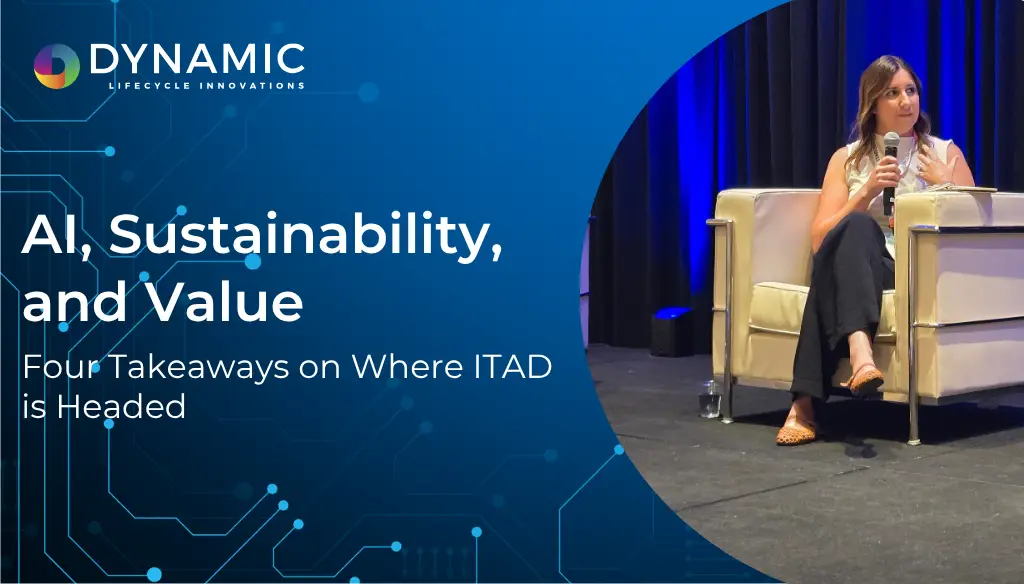
At ReMA 2026, I joined a panel of industry leaders to discuss what many of us are already seeing firsthand:
The IT asset disposition (ITAD) and electronics recycling industry is at a true inflection point.
Across the discussion, a clear theme emerged. While our industry has always adapted to change, today the pace and the pressure feel different. AI is becoming part of daily operations, data center growth is reshaping the flow of equipment, and global volatility is making long-term planning more complex.
From where I sit, these shifts are not theoretical. They are already changing how we operate and how our customers expect us to deliver.
AI in ITAD: Practical, Not Hypothetical
AI is already delivering value across the ITAD industry. It is just not always in the ways people expect.
At Dynamic, we have focused on practical applications that improve speed and accuracy without adding unnecessary complexity. Even something like using optical character recognition (OCR) to capture serialized asset has helped reduce manual entry and improve consistency across operations.
We are also exploring how AI can support faster decision-making by identifying devices, evaluating value, and helping determine the best downstream path for reuse or recycling.
What is becoming clear is that AI works best when it supports the work, not replaces it. It allows teams to move faster and with more confidence, while human intelligence remains critical for context, quality, and risk management.
For organizations evaluating AI in ITAD, the opportunity is not just automation. It is better, faster, and more informed decision-making across the asset lifecycle.
AI Is Reshaping the Market, Not Just Operations
AI is also driving broader changes across the IT asset disposition and electronics recycling landscape.
We are seeing increased demand for enterprise and data center equipment, along with constraints in key components like memory. In some cases, manufacturers are shifting capacity toward enterprise production, which is starting to impact availability on the consumer side.
At the same time, the equipment itself is evolving. Assets are becoming more specialized, with new configurations, materials, and cooling systems that do not always fit traditional reuse or recycling models.
The result is a more complex operational environment. We are not just handling more volume. We are managing a wider range of asset types, often with new processes being developed in real time.
This shift is especially visible in data center decommissioning and hyperscale environments, where scale, specialization, and service expectations continue to increase.
Growth Is More Competitive and Strategy Is Shifting
Growth across the ITAD industry is becoming more competitive.
Most enterprise organizations already have established providers, and those relationships are not easy to displace. That is one of the reasons we are seeing increased activity in mergers and acquisitions across ITAD and electronics recycling.
Companies are looking for new ways to:
- Expand capabilities
- Enter new geographic markets
- Strengthen their service offerings
But in a highly customized industry like ours, growth is not just about scale.
It comes down to alignment between operations, customer expectations, and organizational culture. Without that alignment, growth becomes much harder to sustain over time.
Certifications Are Shifting and Data Is Driving It
Another clear shift is happening in how ITAD certifications and compliance frameworks are evolving.
While environmental compliance remains critical, data security is becoming central to how organizations evaluate ITAD partners.
In recent audits, it has been clear that expectations are expanding beyond device handling to include how data is managed across systems, infrastructure, and processes.
This is driving increased emphasis on:
- Traceability and chain of custody
- System-level data security
- Certifications such as SOC 2 and ISO 27001
These changes are being driven directly by customer expectations. Organizations want more transparency and more assurance across the full lifecycle of their assets.
Industry standards and organizations like the Recycled Materials Association (ReMA) continue to play an important role in helping companies stay informed on evolving certification, regulatory, and best practice frameworks.
Volatility Is Changing How We Plan
If there is one constant in today’s ITAD and electronics recycling environment, it is change.
We have seen strong commodity markets offset by rising logistics and fuel costs. We have also seen ongoing shifts in global trade dynamics, tariffs, and regulatory requirements.
That makes forecasting more difficult and requires a more flexible approach to ITAD strategy.
One of the biggest advantages in this environment is diversification. Organizations with multiple service lines across ITAD, recycling, logistics, and commodities are better positioned to absorb fluctuations and maintain stability.
A Defining Moment for the ITAD Industry
The role of IT asset disposition is expanding quickly.
Today, ITAD providers are expected to:
- Manage data security and compliance
- Support circular economy and sustainability goals
- Navigate global regulatory requirements
- Adapt to rapid changes in technology and infrastructure
This is not just another cycle of change. It is a shift in what the industry requires.
For organizations that are willing to evolve and invest in the right capabilities, it is also a significant opportunity to lead.
Want to talk through how these trends are impacting your organization? Our team is always open to sharing insights and comparing notes.
Related Resources