The Hidden Risk In Sanitized Network Switches and How Dynamic Eliminates It
Executive Summary
To evaluate the effectiveness of sanitization practices within the IT asset disposition (ITAD) industry, Dynamic Lifecycle Innovations conducted a controlled experiment. The goal was to determine whether networking equipment labeled as “sanitized” by other ITAD providers truly had all user data securely and completely removed. Partnering with independent forensics firm CPR Tools, Dynamic analyzed two enterprise-grade Cisco routers purchased from competing ITAD providers, each advertised as securely wiped and ready for resale. The results were revealing.-
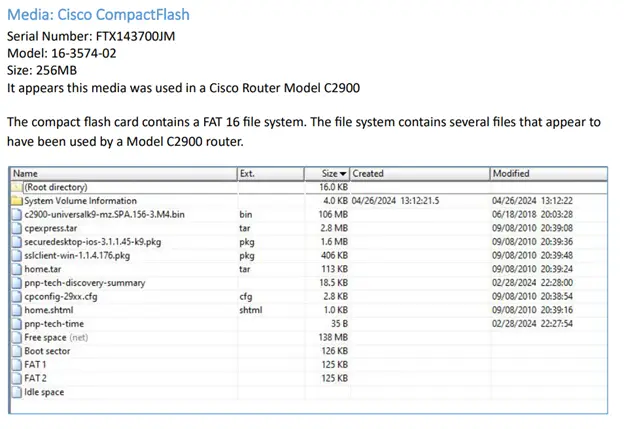
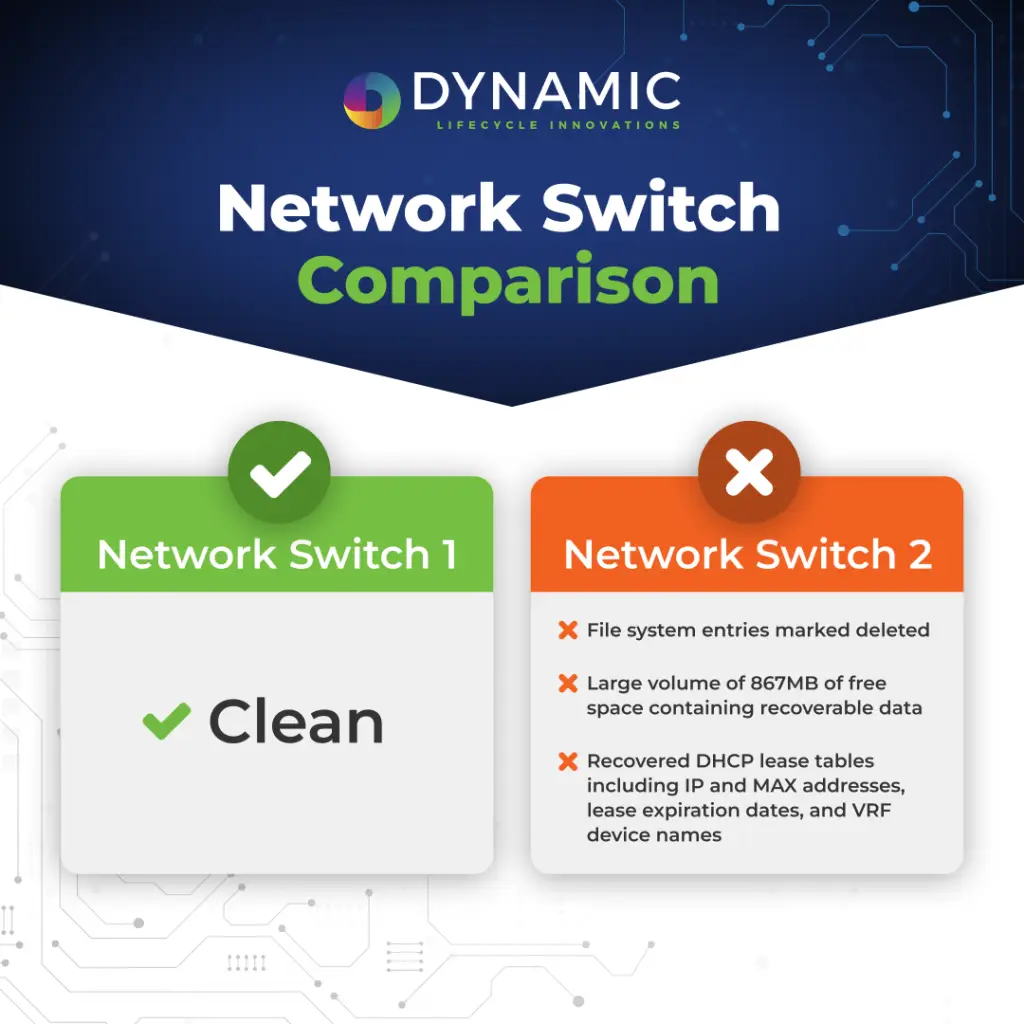
- One router’s compact flash card was clean, containing only factory-default configuration data.
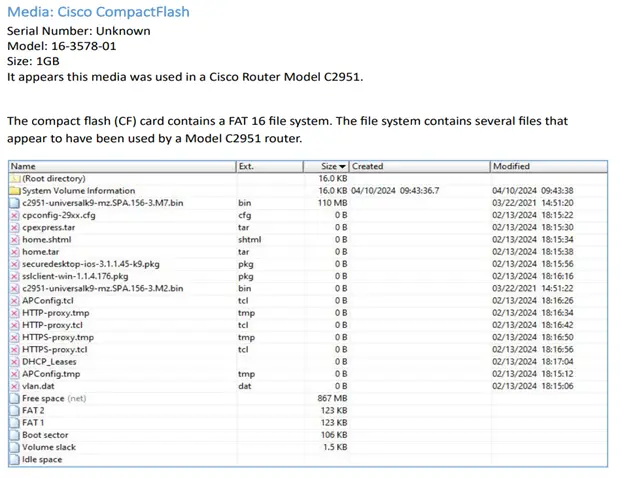
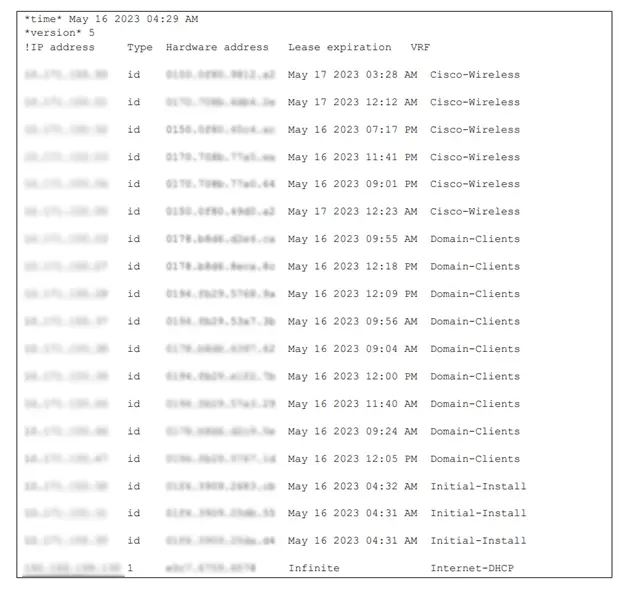
- A study of the 867 MB of free space on the compact flash card on the second router found that it contained residual information, including IP and MAC addresses, DHCP lease records, and virtual routing identifiers from a prior user environment, all recoverable through standard forensic methods.
This case underscores a critical industry failure: simple file deletions and incomplete sanitization routines do not ensure true data destruction. Even among professional ITAD vendors, improper sanitization can expose organizations to compliance violations, privacy breaches, and brand risk. Dynamic’s response is a verifiable, multi-stage sanitization process that goes far beyond console-level commands. Every action is logged, verified, and independently validated, delivering 100% data erasure success across all forensic test samples to date. In doing so, Dynamic not only mitigates data security risks but redefines what trustworthy sanitization means in the circular IT economy.
Introduction: The Illusion of Sanitization
In an era where enterprise networks manage millions of data transactions daily, the hardware behind that infrastructure becomes a repository of sensitive operational data.
As organizations decommission equipment, they rely on third-party ITAD providers to sanitize and resell their assets. The expectation is clear: when a device is labeled “sanitized,” it should be clean, compliant, and risk-free.
Unfortunately, the industry’s reliance on traditional file-deletion or factory-reset methods creates a false sense of security. While interfaces may appear empty, the underlying storage media often retain fragments of configuration files, DHCP tables, and IP addresses.
These digital fingerprints can, in skilled hands, reconstruct elements of the prior owner’s network environment.
Recognizing this gap, Dynamic Lifecycle Innovations set out to measure the reality behind the “sanitized” label. By purchasing and testing routers from competing ITAD providers, Dynamic aimed to determine whether such devices truly met the standards of secure data destruction.
The findings were unequivocal. Incomplete sanitization practices persist across the market, even among providers claiming compliance. The implications reach far beyond technical curiosity; they touch the core of enterprise data protection, regulatory compliance, and customer trust.
Findings and Technical Analysis
Dynamic Lifecycle Innovations’ controlled experiment produced a clear and measurable contrast between two devices that were both marketed as sanitized. The results demonstrate that not all sanitization processes are created equal and that improper techniques can leave recoverable data behind, even when equipment appears to be wiped. The first router, a Cisco C2900 equipped with a 256MB compact flash (CF) card, passed forensic inspection without issue. Analysts at CPR Tools found only default configuration files and no traces of user data. The second router, a Cisco C2951 with a 1GB CF card, revealed the opposite. CPR Tools identified multiple indicators of incomplete sanitization. The forensic artifacts provide a clear timeline:- The router was likely commissioned or updated around March 2021, as inferred from the OS (.BIN) file timestamp.
- It remained in use throughout May 2023, generating DHCP data.
- On February 13, 2024, a deletion event was executed, but data was not overwritten.
This data persisted beyond the deletion event, meaning that while the files had been flagged as deleted, their underlying data structures were never securely overwritten. The remnants were still accessible using standard forensic recovery tools.
Implications for the ITAD Industry
The findings of this case study expose a fundamental vulnerability within the IT asset disposition (ITAD) industry. Even among providers that advertise compliant and secure sanitization services, residual data can remain recoverable on devices sold as sanitized. This fact poses significant risks for both service providers and their enterprise clients.
Incomplete sanitization has measurable consequences. When data remnants persist on reused hardware, organizations face potential exposure of sensitive network configurations, customer information, and intellectual property. For industries governed by NIST SP 800-88, GDPR, HIPAA, and PCI DSS, this exposure can result in non-compliance penalties and reputational harm.
Dynamic’s forensic findings illustrate several key lessons for the broader ITAD sector:
- Verification is essential.
- Overwriting or cryptographic erasure is required.
- Third-party validation provides assurance.
The ITAD industry must evolve from relying on unverified claims of compliance to adopting provable, testable, and transparent sanitization standards. Dynamic Lifecycle Innovations has already taken that step.
Dynamic’s Sanitization Process and Proven Results
To bridge the gap between industry norms and true data security, Dynamic Lifecycle Innovations employs a multi‑stage, software‑guided sanitization workflow that goes well beyond simple console delete commands:
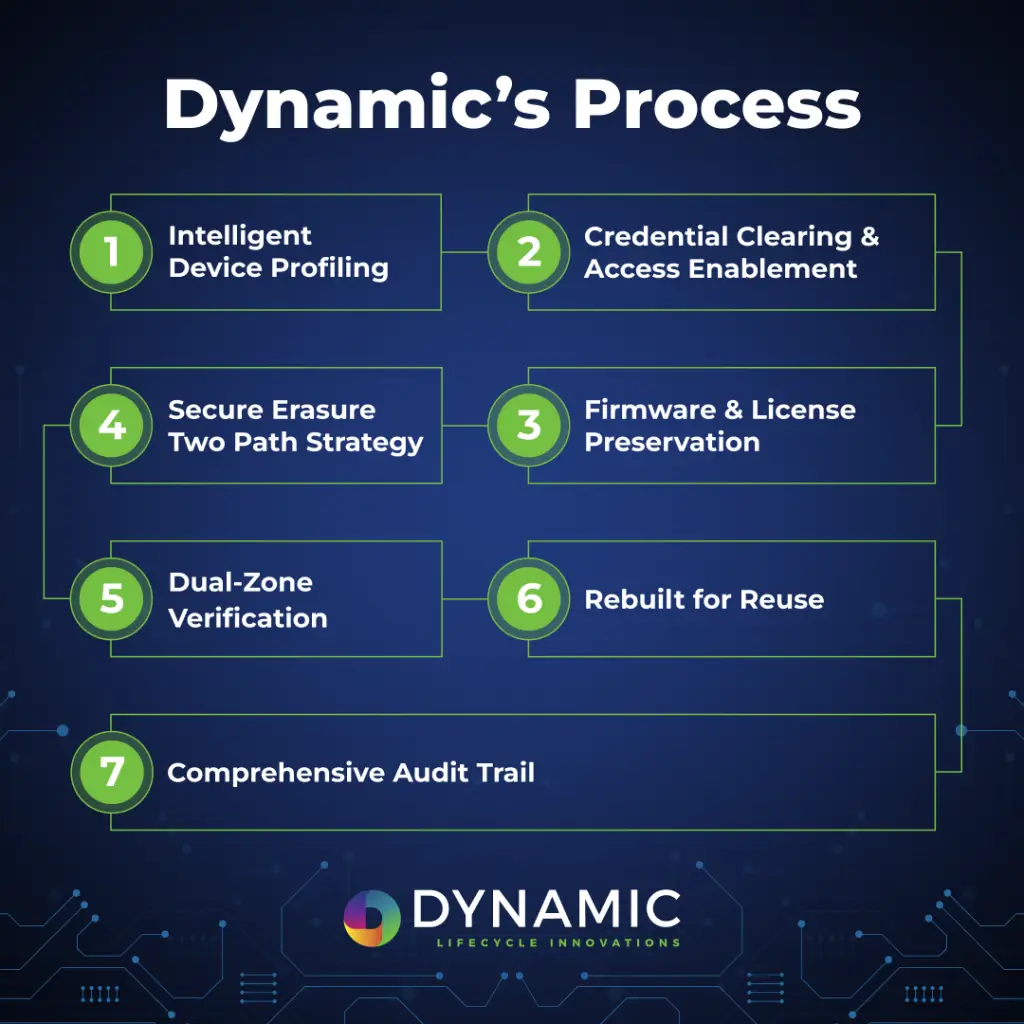
- Intelligent Device Profiling: The solution first probes the device firmware to identify make, model, serial number, and OS/firmware version. This ensures the correct recipe for each platform.
- Credential Clearing and Access Enablement: Configuration files are removed to eliminate legacy passwords and guarantee full administrative access for subsequent steps.
- Firmware and License Preservation: A clean, stock copy of the operating‑system image (e.g., the factory .BIN file) and any embedded licenses are extracted and stored off‑device. This preserves legitimate value for downstream buyers while avoiding the retention of user data.
- Secure Erasure (two-path approach): Firmware‑native secure‑erase commands are executed whenever supported (the preferred path).
If not supported, the process falls back to a validated overwrite of all Flash storage. - Dual-Zone Verification: The system performs a read‑back verification of both Flash and NVRAM to confirm that the Flash storage and NVRAM has been properly overwritten or cryptographically purged.
- Rebuild for Reuse: After verification, the original firmware image and licenses are reloaded, the device is re‑initialized to a default state, and it is prepared for aftermarket deployment.
- Comprehensive Audit Trail: Every action, hash check, and verification step is logged and associated with the asset’s unique identifier to provide a defensible chain‑of‑custody record.
Conclusion
The experiment conducted by Dynamic Lifecycle Innovations and validated by CPR Tools provides clear evidence that not all sanitization processes deliver true data security. The persistence of recoverable data on equipment sold as sanitized underscores the need for verifiable, standards-driven erasure practices.
Dynamic’s multi-stage, software-guided sanitization process closes this gap. It provides clients with a defensible assurance that every device leaving their control is genuinely clean, compliant, and ready for reuse. By combining rigorous process engineering, verification, and independent validation, Dynamic has established a new benchmark for data security and operational integrity in IT asset disposition.
In a market where trust is often assumed, Dynamic Lifecycle Innovations delivers proof.
About Dynamic Lifecycle Innovations
Dynamic Lifecycle Innovations is a leader in IT asset disposition (ITAD), data center decommissioning, and electronics lifecycle management, delivering boutique service with global capabilities. Dynamic helps enterprises, OEMs, and data centers manage technology transitions securely, compliantly, and sustainably—giving electronics their next best life.
Dynamic operates facilities in La Crosse, Wisconsin; Nashville, Tennessee; and Loudoun County, Virginia, and maintains global reach through a validated partner network. Its lifecycle solutions span data destruction, reverse logistics, remarketing, material recovery, and ESG reporting to help organizations protect data, advance sustainability, and maintain confidence in every engagement.
Related Resources