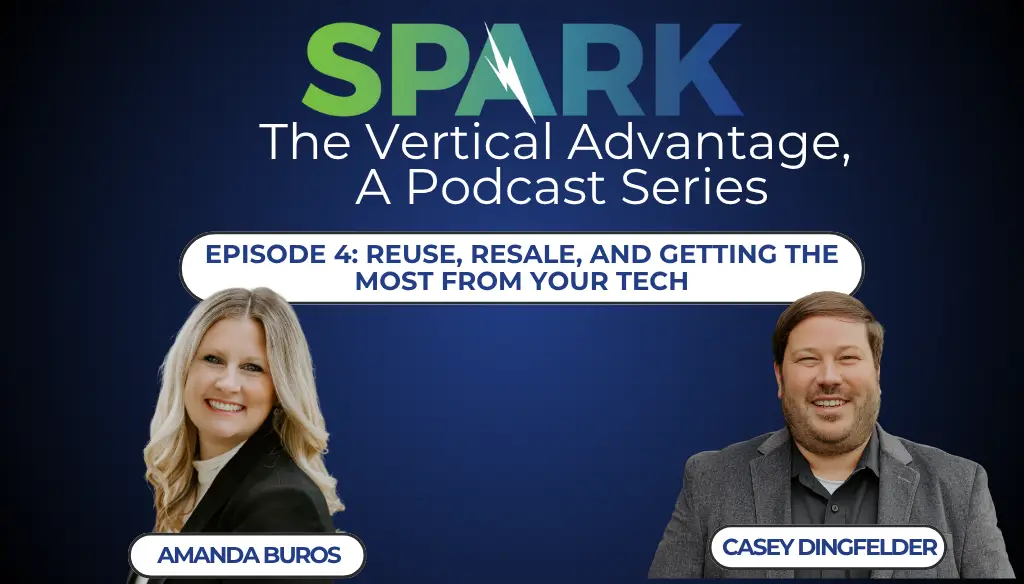
The Vertical Advantage Episode Four: Reuse, Resale, and Getting the Most from Your Tech
Unlock the Hidden Value in Your Retired Technology
In this episode of The Vertical Advantage, host Amanda Tischer Burris, VP of OEM Solutions at Dynamic, sits down with Casey Dingfelder, VP of Business Strategy & Analytics, to reveal why end-of-life doesn’t have to mean end-of-value for your IT assets.
Discover how Dynamic helps enterprises securely refurbish, resell, and redeploy technology—from laptops and mobile devices to full data center hardware. Learn how circularity, advanced software-driven data destruction, vertical integration, multi-channel resale, and onsite services work together to maximize financial return while protecting your brand and boosting sustainability performance.
What you’ll learn:
Why reuse delivers stronger ROI and carbon savings than recycling
How Dynamic evaluates every asset for whole-unit, parts, or component-level resale
The software-driven data security safeguards behind certified refurbishment
How vertical integration enhances chain-of-custody control and brand protection
Real-world customer success examples, including enterprise data center returns
How to simplify ITAD with an “easy button” partner who handles everything end-to-end
Perfect for IT leaders, sustainability teams, data center managers, procurement professionals, and anyone looking to modernize their IT asset disposition strategy.
Featuring guest expert Casey Dingfelder from Dynamic Lifecycle Innovations
View Full Podcast Transcript
Amanda Buros (00:00)
Hi and welcome back to The Vertical Advantage, our podcast series from Dynamic where we break down what really happens with your old tech and what this means for you.
I’m your host, Amanda Tischer Burris, VP of OEM Solutions. At Dynamic, we help businesses recover value from their equipment, keep data secure, and give electronics their next best life. If you’re tired of juggling this and you’re managing IT assets, handling compliance, or running a data center, this is for you. Today, we’re talking about how to get more from your technology and why end of life doesn’t have to mean end of value. I’m joined by Casey Dingfelder, our VP of Business Strategy and Analytics, to explore how Dynamic helps partners securely refurbish and resell their technology.
from business devices to entire data centers, recovering more value while supporting sustainability goals. It’s a smart, secure approach that’s good for the planet and great for your bottom line. Let’s get started.
Amanda Buros (00:55)
So Casey, a lot of companies assume end of life means recycling, whether that’s laptops or racks of servers, but reuse and resale can often deliver more value and greater sustainability. Why is reuse such an important part of the conversation today?
Casey Dingfelder (01:09)
Hey, Amanda. Thanks for having me today. Yeah, I’m excited to talk about reuse and all the possibilities and value that it will return back. ⁓ First, I want to start with just the circularity. So being able to reuse products, the carbon emission avoidance from being able to extend the lifecycle of that device is tremendous. The calculations that we’ve done as far as the mining of new minerals, materials to manufacture a new device.
compared to what the reuse side for the circularity brings is tremendous. From a value perspective, reuse, what we find is most of our customers from a reuse standpoint actually get a check back every month from us. And what that means is that the value of their equipment from a reuse standpoint outweighs the cost of logistics, outweighs the cost of the other services that they’re incurring. So when you look at the total recycling package, some products are tough to manage. There’s hazardous materials, there’s hazardous waste sometimes in that stream. The reuse can actually
way all those costs associated with the recycling site.
Amanda Buros (02:06)
Great. Thank you. That’s great for setting the stage for our conversation today. So when we talk about maximizing the life of technology, what does dynamics approach to refurbishment and resale actually look like?
Casey Dingfelder (02:18)
Yes, so Dynamic, we really take the approach of we evaluate everything for reuse, resale value. ⁓ We first look at what’s the value of this if we keep it whole.
⁓
When we’re looking at the value of the whole machine versus the value of the parts, we’re looking at what’s the best value for our customer and then also what’s the best value for Dynamic. Those two things work parallel together. Like if it’s best for the customer, it’s always going to be best for Dynamic as well. And then lastly, what we also look at is if we have a machine, we understand the market and we understand what’s trending, what’s really highly desirable. We sometimes will take a machine as is and build it up to add higher specs. So we might increase the
RAM we might increase the hard drive on a laptop all to make it more appealing for specific buyers that would want that machine so we’re constantly looking at how can we extract more value or how can we add more value back that would benefit both the customer and us.
Amanda Buros (03:12)
Yeah, great. That’s a really good insight on how Dynamic has a little bit of differentiation outside of just some standard e-comm sales, right? So in addition to the information you shared with me, does that include everything from end user equipment to data center assets? How do those reuse opportunities differ by type or scale? Is there anything you want to add to that?
Casey Dingfelder (03:33)
Yeah, there’s a lot of similarity, whether it’s endpoint devices or a data center equipment. I think on the data center side, there’s a lot more technical. Some of the equipment or material might be proprietary to the enterprise that’s using that equipment in their data center. But we’re doing the same process where we’re looking at the machine whole, even the rack. So a lot of times the server rack itself is just a steel rack that holds the servers. We’re still looking at the rack. Maybe that has
value to someone else. Sometimes the rack just needs to get recycled and it’s the server itself. So on the enterprise side, there’s a lot of equipment from switches, servers, to the cooling, to the generators, the UPSs. So it’s the same process, just different types of material that we’re evaluating.
Amanda Buros (04:18)
So Casey, moving on to focus a little bit more on secure refurbishment and some compliance points, how does Dynamic ensure refurbishment and resales stay fully aligned with compliance standards from data destruction to device condition and reporting?
Casey Dingfelder (04:32)
Yes, data destruction or data protection is the number one goal here at Dynamic. So what we have in place from a protocol standpoint is all the machines that come through Dynamic, whether it’s a server, whether it’s a laptop, a cell phone, we have to run it through our software. So our software has the ability to actually detect if there’s a data storage device on board. So it could just be your traditional hard drive, but with the evolution of technology, we’re finding that there might be a standard hard
drive in a laptop, but then also there’s a secondary hard drive that’s underneath the keyboard that wouldn’t be visible when you take off the back plate. So the software is going through and detecting any data storage components on board. And if the machine does not power on or fails that test for whatever reason, we move to recycling or destruction of that device. It has to give us the software approved verification that there is no data present. After we have
concluded that there is no data storage device on board. We then move into testing and all of our tests are done through software as well. So then we have a record of all the tests that were performed. It could be anywhere from a hundred different tests on laptops to 40 different tests on cell phones. We have a digital record on each device of what test was performed, whether it passed or failed that test.
Some of the other things that would come into play on this, we’re seeing a lot of…
software locking that’s more present on devices that we’re receiving. So we’re receiving devices from our clients that have these locks present. There’s sometimes what referred to as a digital asset tag or like a splash screen of that enterprise’s logo or it just, there’s some sort of identifying information there. We remove all those locks. If we’re not able to remove those locks, those devices also go into destruction as well.
So when we run a device through our refurbishment process when it comes out the back end It’s unrecognizable of where it came from who it was connected to at any point in its life.
Amanda Buros (06:28)
It’s good to know for customers that care about their brand that we have those different checks and balances in place. I think we talk a lot about some of the challenges with the unlocking and those the devices that come in locked. So obviously when we’re talking about maximizing reuse and resale, it’s in everyone’s best interest to be able to get those devices locked and give those electronics their next best life. But for customers are really worried about their brand and risk, how does our process safeguard
data security and brand reputation when you’re really talking about moving those assets into resale.
Casey Dingfelder (07:02)
Yeah, again, with us using as much software as we have been able to, it eliminates a lot of the human error. So maybe in the past, before the software existed, it relied on humans to check to see if there’s a hard drive present. And like hard drives blend in when you open up inside of a computer or laptop, like all the components can look very similar. So I think you have that risk of just any time a human’s looking at thousands of laptops over the course of a week.
they could miss one. The software really prevents that. It doesn’t allow the machine to move on to the next step if the data storage has been identified. As far as the customer asset tags or the digital splash screens, having the vertical integration that we have here at Dynamic, we’re able to run it through a shredder that’s on site. We don’t have to find a downstream vendor that will actually shred the material or destroy the material. That’s all under Dynamic’s roof. Even things like from school
Amanda Buros (07:42)
Thank
Casey Dingfelder (07:56)
districts, sometimes they’ll etch their logo or the school district onto the laptop. When you run it through the shredder, it’s unrecognizable because the pieces are granulated almost down to where you don’t even know what that device was. You just see a piece of plastic. they’re not recognizable to our customers or to anyone when they come out the other end.
Amanda Buros (08:15)
Yeah, it’s a great example of why vertical integration with having the ITAD and Resale side combined with the certified destruction or shredding on site is really critical to that brand protection.
Moving on to talk a little bit about maximizing value for our customers. Casey, what kind of financial returns can our customers see by extending product life through reuse and resale rather than just defaulting to recycling?
Casey Dingfelder (08:38)
Yeah, as I mentioned earlier, most of our customers that allow us to resell their assets receive a check every single month. So that means that their cost of logistics, the cost of some of the asset tracking services, the data sanitization process, even some of the hard to recycle categories, all those are costs involved with our services. The value of the reuse return that we’re able to provide back to the customer outweighs that so what they’re actually net positive at the end of it. So laptops that.
that five years or newer probably has resale value or some level of resale value. A laptop that’s three years old is gonna sell for hundreds of dollars compared to the recycling value from a precious metal standpoint. You’re talking dollars per pound as opposed to hundreds of dollars per unit. Cell phones, very similar. $100 on average for iPhone 11, whereas per pound recycling is gonna be a lot lower than that.
So yeah, it’s gonna be substantial.
Amanda Buros (09:35)
Great. So how does Dynamic help partners decide when reuse makes more sense for them versus secure recycling and which might be the better fit for them?
Casey Dingfelder (09:44)
think the biggest way that we are able to help our customers make the decision is we come alongside as a consultant. So we’re not pushing them. If they have certain protocols or standards internally that require the certified destruction, we can adhere to that, provide those destruction services. We can then provide analysis on if they did allow us to resell the equipment versus the destruction, what could be those returns. So we’re able to provide those studies and analysis where they can then start to take that back internally to make the decision on if they want to start
shifting towards allowing for a resale. We also can go through on a product by product level. So maybe some products have more data risks from their perspective than others. And we can kind of do a hybrid approach or maybe they start to allow for resale of certain devices compared to others. Again, we, don’t want to be associated with any sort of data concerns whatsoever. So we’ve put in systems in place that if we can’t get the device unlocked or if we can’t remove this digital asset,
tag or if there is other things that we’re just unable to access we don’t even resell that internally even if the customers felt comfortable with it. So we’ve already in a way protected the customers of building this refurbishment process to fit our comfort level. We’re able to work with our customers,
we take a very collaborative consultative approach. We’ve had customers in the past that required destruction only and then they also wanted us to run a analysis on if they did allow resale, what could that return be? So we’re able to look at the data and report back and say this is what we anticipate the financial returns would be if we were able to resell
Maybe another approach that we can take if it’s a large leap for the customer to go from total destruction to allowing resale is we can evaluate the component value of their units to see what that return would be allowing us to resell the components. So it’d still be a way for the customer to have destruction on the whole unit but still allow for the harvesting of valuable parts and components. So they can kind of still get the best of both worlds
Amanda Buros (11:41)
Yeah, thanks Casey. think being able to show that sliding scale of where we can maximize value at different levels within our reuse capabilities is really important and it also helps your customer be able to find the best ⁓ custom fit for what they’re looking for from a bridging the gap between recycling and reuse opportunities.
Would you be able to share a success story with us where resale or reuse was able to deliver meaningful value uplift for one of our customers?
Casey Dingfelder (12:10)
Yes, a couple of years ago, we have a national healthcare provider that we have as a client and their prior requirements were for us to destroy all server enterprise equipment out of their data centers. And after going through and explaining our process, they were on site multiple times. They were able to see the process firsthand. We were able to get to the point where they allowed us to now start harvesting the RAM and CPUs out of their servers. So that the value of those two components alone was tremendous.
So the return that we were able to provide back was very substantial to that customer.
Amanda Buros (12:44)
That’s great. And to your point from the beginning, probably helped offset some costs for some of their other materials that needed recycling or end of life management too.
So Casey, circularity is becoming a business advantage, not just a buzzword. What does a circular model look like in practice for Dynamic? When we talk about maximizing reuse and resale, can we talk a little bit about what our vertical integration looks like from the point of logistics pick up through data destruction to reuse or recycling?
Casey Dingfelder (13:12)
We have our own logistics fleet. We have tractor trailers, box trucks that
from all throughout the country to pick these assets up. As we pick them up, we have a secure chain of custody with our badge employees that comes back to a Dynamic facility. We capture all the reporting. So the asset tracking is what we refer to it internally so that we can report back to our customers of what the assets we received from them were. From there, then we really need to answer the question of what did we do with it? So that’s where we’re separating and triaging what’s reuse, what’s recycling. The reuse as we’ve talked so far is just we’re going to look at the whole unit machine.
itself. We’re going look at the parts value, the components, we’re going look to build the machine up on the items that we deem that aren’t desirable or don’t have high demand from a reuse standpoint. We recycle and then internally with our vertical integration, the shredding system that we have in place, we’re able to shred down to the plastics, the aluminum, the copper, the precious metals, and that material then is sold back into the manufacturing sector to be reused into making new materials. So the customers
that we are working with that are sending us material are benefiting from Dynamic Total Process because there’s carbon emission avoidance happening at every step of the chain and because we’re able to capture either the reuse value or the the material the commodities itself.
Amanda Buros (14:34)
Great, thank you so much. Moving on to one of the things that I think separates Dynamic from the pack and that’s really ease of use for our customers and our partners. So from the customer perspective, reuse can seem kind of complex. There’s testing, refurbishment, different reuse channels. How does Dynamic make the process simple and turnkey?
Casey Dingfelder (14:54)
Yes,
We want to make it easy for the customer. We want to be easy to work with, easy to use. So most of our customers don’t know what they’re even sending to us. They just say that they have six bins or seven pallets of material that need to get picked up. We pick that material up and we bring it in and then they rely on us to report back what they received.
They don’t even need to go through and identify what they’re going to be sending to us. We want to provide that service to them of, just accumulate it, tell us when you have enough that you need picked up. So we’ve really prided ourselves on being considered easy to work with.
Amanda Buros (15:27)
Yeah, great. I think when we talk about vertical integration and full capabilities, maybe one of our better kept secrets too is that we can support some larger onsite projects as well. So for large data center or IAT asset disposition products, how does Dynamic handle onsite collection, verification and resale so customers actually can reduce the multiple vendors that they’re working with?
Casey Dingfelder (15:50)
the one thing that separates us from other ⁓ companies in this space is we don’t necessarily want just your reuse or just your recycling. We want to be able come in and take everything that you have. So you don’t need two vendors, one to take your recycling and one to take your reuse. A lot of times when it’s an onsite data center decommissioning or white glove operation that needs to take place, we just talk with the customer, understand the scope of how many assets are they estimating, where’s the facilities located, and then we can deploy our own team members.
to their site to actually collect track on site so then we give them a report before we leave that they sign off on that yes, Dynamic is taking possession, Chain of Custody has now moved to Dynamic on all these assets. These assets then arrive at our facility, one of our facilities, and then we’re able to cross-reference that on-site tracking report to the in-house tracking report and those two reports will match to show that there is no assets lost in transportation.
Amanda Buros (16:41)
Great. Thanks, Casey. So another thing that’s unique maybe to Dynamic is that we don’t just resell through one outlet. You’ve built wholesale e-commerce and parts harvesting channels and we have multiple avenues in which those materials get sold every day. So how does this multi-channel model maximize returns for our customers?
Casey Dingfelder (17:01)
Yeah, so we’re again, we’re looking at the whole machine, the parts, the components. also we’re looking at the value of the machine, the parts again.
And then the recycling value of all the material that we’re receiving. We’re comparing that to what we could sell at domestic for international markets. We’re even exploring more and more opportunities to sell back into OEMs, whether it be hard drives or different components that the manufacturers want, or maybe there’s a shortage.
there’s initiatives now where OEMs want a certain percentage of their sales to be secondary products because they have sustainability goals that they’re trying to meet. So we’re seeing more and more of that gain popularity. So we’re constantly looking at where can we maximize the value by what channel, what channel do we essentially need to sell this into.
Amanda Buros (17:46)
Great. Okay,
if I’m a customer listening today, what’s the first step I should take to explore resale and reuse opportunities?
Casey Dingfelder (17:54)
Yeah, I would recommend the first step is to just look at the current reporting that you’re receiving from your current provider. Are they breaking it out? Are they being transparent with what they’re reselling, what they’re recycling? If you’re a certified destruction only and you don’t allow the resell, it would just probably be looking at the type of assets that you’re shipping out. Just what’s a general age of it. Again, if it’s five years or newer, there’s going to be resale value there.
Amanda Buros (18:18)
what’s the one takeaway you’d want listeners to remember about Dynamic role and helping them get the most out of their technology?
Casey Dingfelder (18:25)
So there’s two things to remember. We’ve been very intentional in wanting to make this easy to use. We want to become the easy button for our customers. The other side of it is transparency. So we want to be easy and transparent for our customers. I hope all of our customers would say that about us, because we really take a lot of pride in both those things. That, I think, is the differentiation and the separation that Dynamic can provide.
Amanda Buros (18:47)
Excellent.
Well, that wraps today’s episode of the Vertical Advantage. Huge thank you to Casey for showing how Dynamic helps partners capture more value through secure reuse and resale opportunities, all the way from enterprise devices to data center hardware. With our integrated approach, partners can extend asset life, protect their data and brand, and achieve their sustainability goals all in one seamless process. So thanks for listening and join us next time as we continue to explore how Dynamic vertical integration helps partners move confidently through every stage of the technology lifecycle.
Meet The Speakers
Amanda Burros is the VP of OEM Solutions at Dynamic Lifecycle Innovations. Connect with her on LinkedIn today.
Casey Dingfelder is the VP of Business Strategy and Analytics at Dynamic Lifecycle Innovations. Connect with him on LinkedIn today.
Related Resources