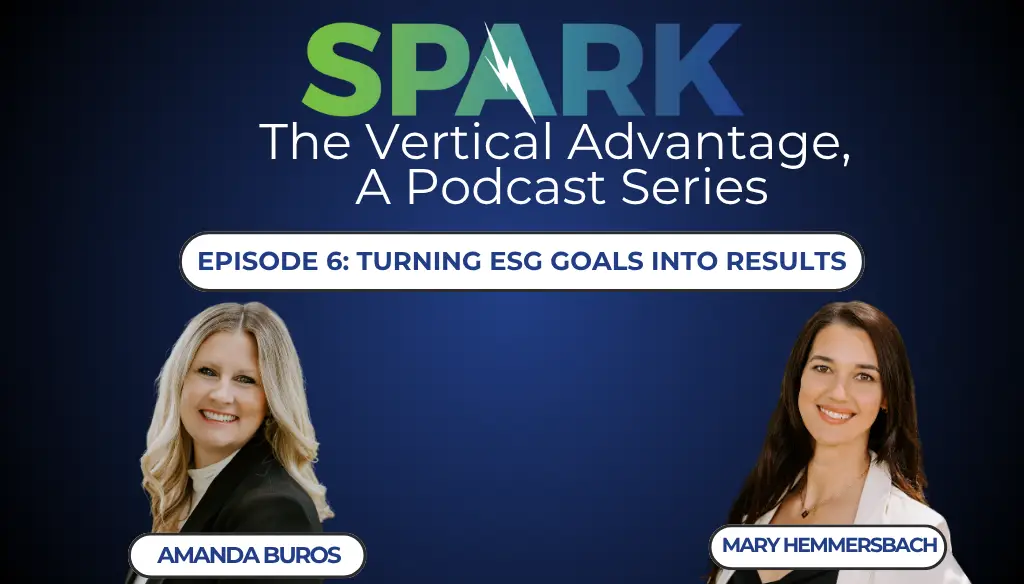
The Vertical Advantage Episode Six: Turning ESG Goals Into Real World Results
How ESG Becomes Measurable: Turning Sustainability Goals Into Proven Results
In this episode of The Vertical Advantage, host Amanda Tischer Buros sits down with Mary Hemmersbach, VP of Technology & Corporate Responsibility at Dynamic, to explore how organizations can turn ESG promises into verifiable performance. From carbon insets to asset-level reporting, learn how Dynamic transforms electronics recycling and IT asset disposition (ITAD) into measurable Scope 3 reductions backed by audit-ready data.
What you’ll learn:
- Why ESG is shifting from messaging to measurable, investor-grade data
- How electronics recycling and ITAD drive Scope 3 emissions reductions
- What carbon insets are—and how they turn avoided emissions into sustainability assets
- How Dynamic’s systems track recovery rates, carbon savings, and landfill diversion
- How verified, serialized reporting strengthens audits, regulatory submissions, and ESG disclosures
- The role of circularity dashboards in visualizing long-term environmental performance
Whether you manage IT assets, lead sustainability strategy, or oversee data center operations, this episode gives you the clarity and tools to turn ESG commitments into measurable, defensible results.
Featuring guest expert Mary Hemmersbach from Dynamic Lifecycle Innovations
View Full Podcast Transcript
Amanda Buros (00:00)
Hi and welcome back to The Vertical Advantage, our podcast series from Dynamic where we break down what really happens with your old tech and what this means for you.
I’m your host Amanda Tischer Buros, VP of OEM Solutions. At Dynamic, we help businesses recover value from their equipment, keep data secure, and give electronics their next best life. If you’re tired of juggling this and you’re managing IT assets, handling compliance, or running a data center, this is for you.
Today, we’re diving into a topic that’s top of mind for nearly every organization, turning ESG goals into real measurable results. I’m joined by Mary Hemmersbach, our VP of Technology and Corporate Responsibility, to talk about how Dynamic helps partners back up their sustainability commitments with real data from scope 3 reductions to audit ready reporting and verified carbon insets. It’s all about moving ESG from promise to proof.
Let’s get started.
Amanda Buros (00:54)
So Mary, one partner recently told us, we can’t just say that we’re sustainable anymore. We have to prove it. Why is measurement such a critical part of what ESG has become today?
Mary (01:04)
Thanks, Amanda. I’m really looking forward to having this conversation. The quote that you shared sums it up perfectly. For years, sustainability was something companies talked about. Now, it’s something they have to demonstrate. Investors, regulators, and even customers expect data, not just intent. At Dynamic, that’s where technology becomes a differentiator. We’re giving our partners, from hyperscale data centers to Fortune 500 organizations to OEMs, the systems and data sets that they need to quantify their environmental performance.
So it’s not just we recycle responsibly. It’s here’s the carbon avoided, here’s the recovery rate, and here’s the traceable proof behind every asset. That’s how ESG becomes measurable and defensible.
Amanda Buros (01:48)
Thank you, Mary. As we start to dive in this morning, can you break down what ESG really means for our customers and where electronics, recycling, and ITAD fit into that picture?
Mary (01:58)
Sure, absolutely. ESG stands for environmental, social, and governance. It’s the framework companies use to evaluate and report on their impact beyond financial metrics. Dynamic contributes mostly directly to the environmental side, helping our partners reduce waste, extend asset life cycles, and minimize carbon emissions through responsible reuse and recycling. Whether it’s enterprise end user hardware, like laptops and tablets, or data center infrastructure, like servers and racks, every asset carries embodied carbon. By managing those assets transparently, we help customers then turn responsible disposition into measurable environmental progress.
Amanda Buros (02:36)
Great. That background is really helpful. So, from your perspective, what’s changed in the past few years that’s been driving this shift from ESG as messaging to ESG as measurable data?
Mary (02:48)
The shift really comes down to accountability and access to better data. Requirements and pressures have tightened and the digital transformation means companies finally can measure things that they couldn’t before, things like energy, emissions, and circularity. We’ve also seen ESG evolve from a sustainability teams initiative to a cross-functional priority that now includes teams like IT, operations, and finance. That’s where Dynamics Vertical Integration really helps because we connect all those dots in one data set.
Amanda Buros (03:16)
Excellent. A lot of companies are focused on scope 3 emissions, which can be the hardest to track. What does Dynamic or how does Dynamic help partners demonstrate meaningful reductions in this area?
Mary (03:28)
Yeah, you’re absolutely right. Scope 3 is where most emissions live and it’s where we make the biggest impact. For data centers, that means tracking the embodied carbon and hardware from manufacturing through end of life. When equipment is redeployed or reused instead of scrapped, we can quantify those avoided emissions. For OEMs and our enterprise IT programs, it’s about asset recovery and refurbishment. Every device that’s resold or reused avoids the need for a new one to be manufactured. That’s a measurable scope 3 reduction.
Amanda Buros (03:56)
Can you walk us through what that looks like in practice? How our data systems capture avoided emissions from logistics, refurbishment, and recycling activities?
Mary (04:03)
Absolutely. Our internal systems capture asset level data from collection logistics to processing and resale outcomes. That data flows into our carbon modeling, which applies ISO 140064 methodology. It’s then independently reviewed by a third party and verified, giving our customers investor grade confidence in their own results.
Amanda Buros (04:24)
Awesome. And carbon insets are kind of a newer concept. So turning avoided emissions into a forward-looking sustainability asset. How does Dynamics support our customers with this?
Mary (04:35)
Carbon insets are about helping companies recognize the real sustainability impact of actions they’re already taking, like refreshing, consolidating, or upgrading technology assets. For the data centers or corporate partners, this doesn’t mean that they’re holding onto hardware assets longer. It’s actually the opposite.
By refreshing equipment earlier, while it still has market value and can be then reused or resold, we’re able to capture that residual value and measure the avoided carbon from preventing new manufacturing, giving electronics their next best life. So instead of aging hardware, consuming more power and losing resale potential, Dynamic helps partners decommission proactively and turn that process into measurable scope 3 reductions. For OEMs, insets then come from circular programs, so recovering materials, extending product life, or reintroducing components into production.
Amanda Buros (05:25)
That’s excellent. So I think as both you and I know, ESG reporting isn’t just about numbers that show up on the slide. How does Dynamic provide the audit ready documentation and traceability because customers are really looking forward to back up their claims?
Mary (05:40)
Yeah, every asset we handle is serialized, tracked, and then tied to a digital record in our ERP systems. From pickup to processing to resale, those data points are integrated, they’re connected, and they feed into detailed ESG reports that quantify the reuse, recovery, and carbon impact. So it’s about the technology that we have and the integrations that we have to help ensure that we can provide the most information back to our customers.
Amanda Buros (06:05)
Thanks, Mary.
Can you share a bit about systems, about the systems or tools behind that, like how asset data, logistics tracking and material recovery feed into a verified ESG data set?
Mary (06:17)
Sure, yeah, to expand on a little bit of what I was just talking about, our ERP platform integrates the processing and resale data. We track chain of custody, we track logistics, data destruction, and material recovery automatically. Then our verified carbon modeling means partners can trust the accuracy of every emission figure. It’s not just a static report, it’s really a living validated data set that’s always changing and evolving, with new information and data.
Amanda Buros (06:44)
Wonderful. And could you share how a partner has used our reporting or audit trails to strengthen their sustainability story, either with regulators, investors or customers?
Mary (06:53)
Yeah, we actually just recently worked with a global enterprise that needed to validate their ITAD program for ESG auditing. Using Dynamics reporting, they were able to verify carbon savings and recovery across multiple regions. Then they integrated that data directly into their annual submission. Initial feedback from them was that their auditor actually cited Dynamics verified emissions data as a model for scope 3 reporting best practices, which was a nice testament to validate how our reporting or how our information can help our customers with their annual reporting as well.
Amanda Buros (07:25)
That’s a great example. From your perspective, what made that one stand out? Was it the depth of the data, the ease of the reporting, or how it connected to a broader compliance or ESG audit process?
Mary (07:36)
Honestly, Amanda, it was all three.
The depth of the data gave their Sustainability and Compliance teams the complete confidence. We weren’t just providing tools. We were delivering the asset level traceability, recovery documentation, and then the verified carbon calculations. The ease of the reporting came from how seamlessly our data integrates into their existing ESG frameworks or their ESG platforms that they’re using. And finally, the connection to their audit process was really what set everything apart.
Amanda Buros (08:05)
So every company has its own sustainability framework from GRI to internal scorecards. How does Dynamic align its data and reporting to fit into these different models?
Mary (08:15)
We’ve been really intentional about building flexibility right into our reporting structure. So whether it’s aligning to GRI for emissions or for waste, our metrics can map directly into those templates already supported by our customers. We also support custom exports or reports for internal ESG dashboards, customized to our solutions that our customers are asking for.
Amanda Buros (08:37)
Great, thank you. So what role does technology play in making that reporting seamless and actionable for our partners?
Mary (08:44)
Technology is really the foundation that makes ESG reporting even possible and reliable. At Dynamic our systems automatically capture and connect data from every stage of the process, logistics, processing, resale, and material recovery. Because those systems talk to each other, partners aren’t spending hours reconciling spreadsheets or chasing down reports. They are getting clean, auditable data that’s ready to plug directly into their ESG frameworks. Our ERP platform and then our carbon calculation translate complex operational data into real-time insights, things like emissions avoided.
It makes ESG performance something that you can measure, visualize, and most importantly, act on, not just report at the end of the year.
Amanda Buros (09:27)
Thanks, Mary. That does sound like a real differentiator.
Would you be able to go a little bit deeper into an example of a dashboard or reporting tool that we’ve developed that helps customers visualize their environmental performance over time?
Mary (09:38)
Yes, one of my favorites is our carbon and circularity dashboard. It shows our customers exactly how their recycling, or their ITAD programs, contribute to emissions reduction and material recovery over time. Also highlights landfill avoidance. It makes sustainability measurable and actionable, and also puts together graphs and visuals to help our customers then act on the data that we’re providing back to them.
Amanda Buros (10:03)
That’s great. It feels like a lot of other companies are still kind of treating ESG like a marketing narrative. So how does Dynamics shift that conversation to more measurable verified outcomes?
Mary (10:12)
By grounding it in data that matters, recovery rates, emissions avoided, pounds diverted, and circularity gain, when you connect these metrics to the ESG targets, sustainability becomes then more performance-driven versus a marketing tactic.
Amanda Buros (10:29)
Great, thank you.
I think you touched on this a little bit, but what are some of the main metrics that really matter, such as recovery rates, emissions avoided, pounds diverted? How did those connect back to ESG targets?
Mary (10:42)
That’s a really great question because the metrics that I mentioned are what turn ESG into something more actionable. The ones that matter most for us are the recovery rates, emissions avoided and total pounds diverted from landfill, directly tied to the core pillars of environmental reporting. Recovery rates connect to circular economy goals by showing how much material reenters the value chain. Emissions avoided align more so with the scope 3 reduction targets and can be verified under frameworks and the other science-based targets initiatives. And then pounds diverted demonstrate waste minimization and resource conservation, key indicators under GRI.
Amanda Buros (11:18)
Yeah, great information.
So what makes ESG success with Dynamic different than just working with a standard recycler or ITAD vendor?
Mary (11:27)
We have the ability to combine integration, transparency, and verification, which sets us apart. Our carbon calculator is backed by Sustainlytics, meaning our partners can report with confidence knowing their data is credible, traceable, and audit-ready.
Amanda Buros (11:42)
Awesome. Can you talk a little bit about the trust factor? How partners know that the data they’re reporting is accurate, defensible, and aligned with their sustainability goals?
Mary (11:53)
In today’s time, trust is everything when it comes to ESG reporting, because once you publish data, it becomes part of your brand, your relationships, and your compliance story. What gives our partners confidence is the integrity of the system behind the numbers. Our reporting is built on verifiable operational data, not estimates or averages. Then we layer on the third-party assurance. Our partners can connect the dots between operational outcomes and ESG performance with total confidence. It’s not just we recycled responsibly.
Amanda Buros (12:23)
So if I’m a sustainability leader listening right now, what’s the first step I should take to make ESG progress real, not just aspirational?
Mary (12:32)
First and foremost, starting out by identifying where your ESG data lives and where it doesn’t. If your IT and sustainability systems aren’t connected, that’s the biggest opportunity. Dynamic can bridge that gap through technology, verified reporting, and traceable performance data.
Amanda Buros (12:48)
And Mary, what’s the one thing you want partners to remember about how Dynamic can help them turn ESG goals into real world results?
Mary (12:54)
With ESG, it isn’t about perfection. It’s about progress that you can prove. So our data is verified, credibly backed, and third party audited. It makes it credible from boardroom to audit, and it’s really about showing that progress again.
Amanda Buros (13:10)
That’s great. If you had to sum it up in one sentence, what’s the value of proof over promise when it comes to ESG?
Mary (13:17)
The proof builds the trust and trust is what drives partnerships, relationships, investment, and ultimately real change.
Amanda Buros (13:25)
Excellent. Thank you so much.
This wraps up our episode of the Vertical Advantage today. A big thank you to Mary for showing us how Dynamic turns sustainability into something tangible, measurable reductions, transparent reporting, and real accountability. When ESG becomes data-driven, progress isn’t just possible, it’s proven. Thanks for listening and be sure to join us next time as we continue exploring how Dynamic’s Vertical Integration drives smarter, more sustainable results.
We’ll see you next time.
Meet The Speakers
Amanda Burros is the VP of OEM Solutions at Dynamic Lifecycle Innovations. Connect with her on LinkedIn today.
Mary Hemmersbach is the OEM Compliance Specialist at Dynamic Lifecycle Innovations. Connect with her on LinkedIn today.
Related Resources