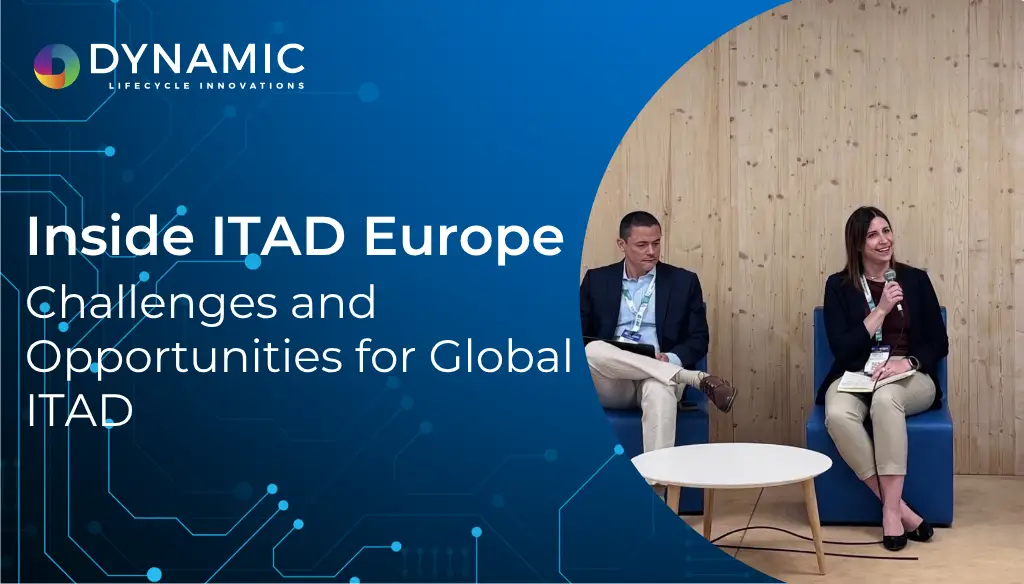
Inside ITAD Europe: Challenges and Opportunities for Global ITAD
ITAD Europe brought together operators, OEMs, and service providers from around the globe in Nice, France.
Ashely Foreman, Executive Vice President of Sales and Marketing and Casey Dingfelder, Executive Vice President of ITAD, sat on panels with top leaders from the global IT asset disposition (ITAD) industry. Their conversations highlighted the challenges facing the market: ESG expectations, increasing complexity, and the shift caused by data centers and artificial intelligence.
We sat down with Ashley and Casey following their sessions—Enterprise Hardware Lifecycle Management: From OEM to End-of-Life and ITAD + ESG: The Next Billion Dollar Opportunity—to break down what they heard and where the industry is headed next.
Q: What stood out most coming out of ITAD Europe this year?
Casey: The biggest takeaway is that the challenges we’re seeing in the U.S. are global. Everyone is dealing with similar friction, especially when it comes to moving equipment across borders and importing electronics into different countries.
What also stood out is a shift in mindset across the industry. There’s a growing recognition that the old model isn’t scalable anymore. There is a large appetite for collaborative partnerships where both companies can win, as people recognize you can’t have a location in every country and service your customers’ needs.
That’s a meaningful change from even a few years ago, and it came up consistently in conversations throughout the event.
Ashley: I agree, it seemed like if you picked up ITAD Summit and set it in Europe, the conversations were the same, but we were surrounded by an entirely different group.
We’re living in a global environment, but the challenges are similar and we’re all trying to navigate the same landscape. Data security, ESG, memory markets, internationally we are all dealing with the same thing.
As a global ITAD, Dynamic is building solutions for these challenges, and this was a great platform to learn from our international partners what ideas they are working on as well.
Q: You mentioned ESG as a challenge. With that being the topic of your panel, Casey, what key takeaways did you have from the discussion?
Casey: I think we need to continue with raising awareness and education on what ESG is. Everyone is trying to do the right thing, but there is just no standardization. So we need to provide that framework, ensure everyone understands the metrics being reported, so that everyone is comparing apples to apples.
Increased data visibility of assets from manufacturing, all the way through end of life, is going to be key on the sustainability side. Data security is still a top priority for any major enterprise, as it should be, but having a transparent model through API or reporting can open up the opportunity for reuse over destruction.
Many organizations still see destroying their data-bearing equipment at the end of life as the safest route. We need to shift that mindset towards value recovery so that we can extend the lives of those assets to promote sustainability.
Q: What would you say to a company that is destroying drives for sercurity to give them confidence in reusing those devices?
Casey: I would encourage them to weigh ESG as much as they are weighing the data security aspect.
There is so much more control of devices than there was 10-15 years ago when it was really just trusting the device was erased.
A lot of data is stored on the cloud there isn’t as much on the physical device, plus there are enhancements to the controls an enterprise has over their technology.
Sustainability needs to have as much weight as data security. There are certain security risks that are no longer risks; they have been mitigated. At the same time, there is an opportunity with sustainability to make gains because of this reduced risk.
Q: Ashley, you talked about the challenges being similar around the globe. As you spoke on the OEM to end-of-life journey, what insights did you find about these challenges?
Ashley: We talked about those challenges in a global sense. From an OEM standpoint, we talked about the supply shortages occurring right now that are very similar to those experienced during the COVID time. With the rise of data centers, many companies are facing those same challenges again.
In addition to the challenges, we discussed the ways our industry is able to help data centers from a sustainability aspect. The negative public perception of data centers exists across the world, and ITAD is uniquely positioned to provide benefits to these data centers by giving their decommissioned equipment a new life.
These data centers are facing a lot of pressure from different angles about the resources they are utilizing, the disruptions in the supply chain they are causing, and the discussion has become what the ITAD industry can do to help them with their image through responsible reuse.
Q: Giving electronics their next best life and providing sustainability benefits seems like a win-win. Was there a lot of focus on this?
Ashley: There is, we discussed how these supply chain shortages are changing both customer behavior and enterprise behavior. We are seeing organizations want to buy secondary equipment, that are looking to harvest equipment, and all the challenges that come along with that.
This helps drive home the point of having strong partners that can handle their needs and service all of their locations. When an ITAD provider has strong, certified partners that can act as an extension of their own organization, it helps clients get the best sustainability results.

Their conversations highlighted the challenges facing the ITAD market around the world: ESG expectations, increasing complexity, and the shift caused by data centers and artificial intelligence
Q: The strength of partnerships keeps coming up, especially when operating on a global level like Dynamic does. What did you learn from talking with international partners at the show?
Casey: What came through in both in the panel and in conversations is that multinational organizations expect consistency across their entire footprint.
They’re not approaching lifecycle management or ESG on a country-by-country basis. They’re setting company-level standards and expecting them to be met everywhere they operate.
That includes data security, environmental responsibility, and overall compliance. In some regions, local regulations may raise the bar even higher, but the baseline expectation is already elevated.
Ashley: It means you have to think in layers. There’s the country-level requirement, regulations, import/export rules, local standards. And then there’s the customer-level requirement, which is often just as strict, if not more so.
The challenge is meeting both at the same time.
But there’s also an advantage. Once you understand how to support a global organization through these partnerships in one region, there’s usually overlap in what they expect elsewhere. That knowledge becomes transferable.
So the more exposure you have globally, the more prepared you are to scale those programs.
Q: What is a key piece of advice you would give after speaking at the ITAD Europe conference?
Casey: I think it would be to expand your boundaries, especially if you have the chance to attend a show like this with global thought leaders in the ITAD space. The more you can learn about best practices, no matter the part of the world they are used in, there is something to learn.
Sometimes things in the US are behind those in Europe, so working with someone in that part of the world is going to allow you take some things away. Looking at data security, things like GDPR, give insight into what could be coming for the U.S.
Broadening your horizons also helps you meet with more partners and expand your capabilities. You can improve downstream markets due to higher demand for a certain product in different regions than there is in the U.S. So expanding your view can benefit your knowledge and your business.
Ashley: We talked about the partner network, and that is my biggest piece of advice. If you are an ITAD, make those partnerships. If you’re an enterprise exploring providers, ask questions about your vendor’s partners.
No ITAD can do 100% of the processing globally. We need to leverage a strong partner network, and meeting with those partners leads to great conversations and shared learning.
The Bottom Line
ITAD Europe made one thing clear.
The industry is becoming more connected, as partnerships become more important.
“I was shocked at the number of international companies looking to partner with Dynamic.” said Casey. “As the industry changes, and new challenges arise, making those connections is important to serving our customers.”
Global challenges are shared. Standards are rising. And partnerships are becoming essential.
To learn more about Dynamic’s global ITAD capabilities, schedule a 15-minute consultation today.