Planning and Executing Successful Onsite ITAD Projects
There’s a big difference between getting retired technology off a loading dock and successfully executing an onsite IT asset disposition project.
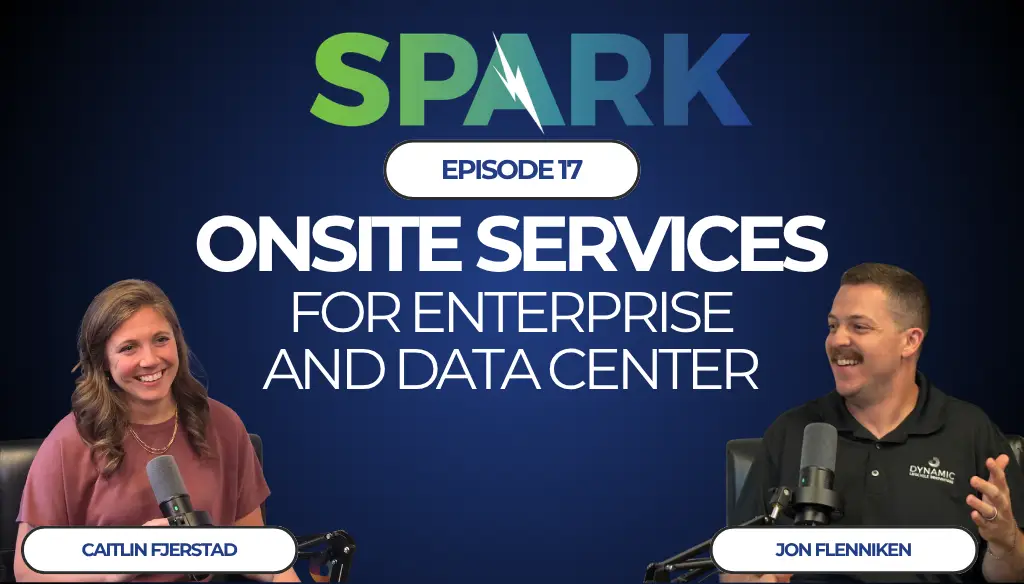
In this episode of the SPARK Podcast, we explore what goes into planning and executing onsite ITAD services for enterprise and data center environments, from asset tracking and data destruction to de-racking, logistics, security, reporting, and project management.
Joining us is Jon Flenniken, Partner Network & Field Services Manager at Dynamic Lifecycle Innovations. With more than 10 years of industry experience, Jon has supported national and global onsite projects across both enterprise and data center environments.
Together, we discuss:
- What onsite ITAD services can include beyond pickup and transportation
- Why scope, inventory accuracy, timelines, and site requirements should be addressed early
- How experienced onsite teams help organizations reduce operational burden and project risk
- What makes data center projects more complex than typical office IT refreshes
- How technicians safely execute projects around active infrastructure
- Why flexibility matters when the scope of a project changes onsite
- How reporting and sustainability requirements factor into project planning
- What to look for in an ITAD partner that can support both one-time projects and ongoing programs
Onsite projects can range from desk-to-desk technology refreshes to complex data center transitions involving heavy infrastructure, strict deadlines, and live environments. In each case, early planning and experienced execution can help organizations maintain security, asset accountability, operational continuity, and confidence throughout the project.
Whether you’re preparing for an enterprise refresh, data center relocation, decommissioning project, or recurring onsite ITAD program, this conversation offers practical guidance for planning the work before technicians ever arrive onsite.
Featuring
Jon Flenniken
Partner Network & Field Services Manager
Dynamic Lifecycle Innovations
View Full Podcast Transcript
Hi, and welcome to this episode of the Spark Podcast hosted by Dynamic Lifecycle Innovations. Today we’re talking about an aspect that can make or break an enterprise or data center iTAD project, on-site services. There’s a big difference between simply getting equipment off of a loading dock and successfully executing an on-site iTAD project. We’ll be learning how a comprehensive on-site plan can impact things as immediate as deadlines and as long term as auditable.
Fiscal or quarterly reporting. Data center work is part of ITAD or IT asset disposition. And many of the same fundamentals do apply. Planning, security, asset accountability, logistics, and communication. But the environment or the setting can be very different. So today we’re going to be talking about what stays the same, what changes, and what organizations should be thinking about before an on-site project begins. Today we’re joined by John Flanakin.
Our field services and partner network manager at Dynamic Lifecycle Innovations. He brings more than 10 years of industry experience from multiple organizations and has supported both national and global on-site projects for both enterprise and data center locations. So, John, thank you so much for joining us today. We’re excited to learn from you. Yeah, thanks for having me. All right, we’re gonna jump right in here to the questions and start learning. So when people think about IT asset disposition, they often picture trucks picking up equipment, and that’s it.
But what do on-site iTad services actually include and why have they become such an important part of a successful iTad program? Yeah. So the pickup and transportation part is typically the, you know, the end of the on-site project. So that’s when everything’s been wrapped up and the the trucks are rolling away. the on-site services are are more so, you know, the on-site serial number capture, the, you know, taking the servers out of the racks, the racking.
You know, going desk to desk and removing laptops, desktops, monitors. but then things like on site data destruction, you know, shredding hard drives, erasing hard drives on site. there’s a lot of different services that that really, you know, and kind of go into that on site services. So you listed a lot of things there. Do you how often is it that an organization asks you to do a service that you haven’t done before? And are you able to usually do that and accommodate that? Or are there times it’s like, we actually can’t do that part?
Yeah. So, you know, given that we we perform these services so frequent, it’s it’s rare that we run into something that we haven’t done before. there are, you know, certain things that that, you know, we typically don’t provide as far as like powering down equipment. That can be, you know, that can be more challenging, turning things offline that that maybe aren’t supposed to be. So we we would lean on the customer and their internal team to power those devices down. But outside of that, there’s a there’s not a lot of stuff that we can’t service. that’s probably yeah.
And I guess one thing added question too is why have on site services become more more of an important part or a focus part of ITED programs? So, you know, organizations have so much going on. They’ve got more typically than just this one, you know, this one project, regardless of the the scale of it. But the ITED services bringing on the right partner allows them to focus on what they need to to keep the business running. it allows the, you know, the experts, the professionals to come in
and do what we do on a daily basis. So we can come in, take that burden off of the organization, and really just come in and, you know, take it over. It can help minimize, you know, downtime, and then obviously, you know, security risks. Our team is, you know, with our certifications, you know, we’re always watching out for for the data security side. So really ensuring that there’s no, you know, issues there. Yeah.
No, that’s awesome having that trusted partner to be able to take care of. And in so many organizations, IT teams are continuing to be asked to do more. So having a a trusted partner that they can rely on to take care of that so they don’t have to staff their team to do that is yeah, I’m sure pretty helpful for them. Absolutely. Okay, so moving on to the next question here. What are some of the biggest challenges that organizations do face when planning an on site ITAD project? And I mean, that could be whether it’s an end user for organizations.
end user type of devices or for data centers. Yeah. So underestimating the scope can can be a real a real challenge there. but then you know things like asset inventories, they might be out of date. So we don’t know, you know, exactly what what to expect when we’re getting on site. project timelines can shift, things like that. There’s those are those are some of the key challenges. the co-locations you know, for data centers.
We run into strict timelines. you know, y end users might have to be out by a certain date, you know, and they’ve got someone else coming in. And if we don’t get that equipment out in time, they can face, you know, fines or or penalties. so you know, to avoid that, bringing in the right partner, making sure we hit those deadlines, really just really helps prevent that challenge at least. Yeah. And so when you’re thinking of all those challenges,
How does an IT vendor really help ensure that their planning can avoid some of those those challenges for organizations? Yeah. So getting ahead of it, you know, understanding what needs to be removed, what what needs to be disconnected, and how data needs to be handled. So planning all of that up front so that there’s, you know, less delays during the the project in real time. Yeah. And how about too, as you mentioned, sometimes things can can shift. How do you make sure that
you can shift. What do you look for? What should organizations look for when they’re thinking of ITAD vendors? Ideally planning ahead of time, of course, but how do you how do you shift otherwise when those changes come mid-project? Yeah. So you really have to lean on your IT partner to to be able to handle that. You know, there should be experienced account managers that that can pivot and flex in real time. You know, we we run into it. we ran into a a project recently where, you know, our team was on site
And the original scope is to take out servers from a rack and and get packaged and and shipped off site. And it turned into a a a full blown you know, clear out. So it’s taking out the racks, taking the servers inside of removing hard drive, shredding on site. It became, you know, this this larger project that just wasn’t planned for. but, you know, having the right partner, they’re able to e execute, get additional team members out if needed, and complete it, you know, in the time frame, you know, required. Yeah.
That’s a lot of project management that goes into it, I’m sure, as well. To be able to pivot, as you mentioned, the deadlines are always very tight for these kinds of projects, especially with data centers, and to be able to accommodate with the change of project is is really impressive. So congrats, awesome job. So now that we’ve talked about some of the the challenges as well, moving into some of the benefits of using partner versus trying to do it yourself as an organization when you’re thinking about on site projects. So
If you can talk about some of the benefits of using partner versus trying to do it themselves. Yeah. So again, you know, going back to kind of the organization’s internal teams. They typically don’t have people that are just standing around, you know, nothing to do. so making sure, you know, you you’re bringing on a partner to take that, take that on for you. They’re coming in. they’ve, you know, they’ve done this day in, day out. they understand the complexities, the scale behind some of these takeouts.
and again, the the risks that that come with it. so it allows them to keep their business running, bring, you know, the partner’s trained technicians in, their standardized processes that the partner, you know, has. it it’s just a a good way to take that burden off of the organization themselves. Yeah. And then when you’re talking about all the planning ahead of time that your iTED provider should be able to give to an organization, at what
point should an organization bring their iTad provider into the conversation? Is it when the equipment is ready to go or how much earlier in the planning process should they be looped in? On honestly, the earlier the better. you know, getting getting the partner in, we can, you know, look through the overall project scope. We can kind of dig and ask questions and make sure that all the things that that we’re used to are covered, you know, limit any surprises. So the earlier you’re bringing them on, you know, it
It sets the project up for for more success. And what type of planning should be done in terms of the steps before prior to the technicians actually getting on site? What do those steps look like? Yeah. So we’re confirming things like you know, as simple as the building address to make sure we’re showing up to the right place, any building requirements, certificates of insurance that are needed, security requirements, you know, hours, things like that. things like docks, you know, moving, you know.
Some of the stuff in data centers can be, you know, hundreds, if not thousands of pounds, making sure that we can, you know, get that onto our trucks as you know, efficiently and safely as possible. so really just going through and and kind of checking all the boxes and you know, setting up calls ahead of time to go through and just really cover all of this information. It it really just makes it ensures that, you know, the project goes off without a hitch. Yeah. I’m sure that’d be really helpful. And cause my mind went to
Does it need to be asset tracked or shredded or not? But you just listed 10 other things roughly that are not those. And those aren’t questions that maybe everybody thinks about right away. And so to have those steps in place or those check boxes as you said in place is probably really helpful to make sure that that project does go smoothly as well. Yeah, absolutely. Okay, shifting a little bit specifically to data center. How are on-site data center projects different from a typical office IT refresh? So for the data centers, they are, you know.
more so larger. you know, the devices are heavier, more costly. you know, there’s more risks when it comes to, you know, safety, power, overhead, you know, ladder racks. So there’s a lot more concerns that that need to be addressed up front. they’re more complex. you know, there can be things like going into a live environment where you know technicians have to work around devices that are still active and remove, you know, remove the ones that the customer needs taken out.
so ensuring that they’re not, you know, impacting any sort of operation because there’s a lot of, you know, a lot of bad that can come from, you know, pulling the wrong cord. So things like that. But the yeah, really the the margin for error is a lot smaller than you know, a typical a desk to desk takeout where you’re taking laptops, desktops, things like that. So when thinking about on the back end of these projects for data centers.
Y does the reporting look differently? Are there specific types of reports that data centers care about maybe more than a typical office refresh? Can you go into the reporting side of it? Yeah, the reporting is is usually, you know, somewhat customized to the organization itself. What what do they need to see? but overall, you know, we’re tracking the same metrics at our facility regardless of of the device coming out. so we can we can really tailor that. And as far as sustainability goes,
you know, that’s something where it it looks the same kind of across the the client device and and the data center equipment. it might just be a a larger number for the data center enterprise side, just because we’re dealing with a lot heavier items. you know, it it typically puts a a better number out there as far as that offset. Yeah, absolutely. I’m sure too, that’s really helpful for data centers to have some of that.
Or a partner who can provide that reporting to them as well. okay, thank you. Are there any other differences when executing on-site services for even the differences between an enterprise data center versus a co-location data center? So as far as the services go, you know, for the co-locations we’re going in and we’re we’re typically
moving equipment out, some might be staying behind. So the racks themselves, the infrastructure kind of stays behind the actual devices within them is what what’s coming out. for enterprise locations, you know, it can be more of a, you know, the customer has to vacate. They’re moving to a new building or or something altogether. so we’re taking everything out from cables under the floor in the ceilings to the racks hanging above. so it enterprise takeouts are usually a bit more involved.
not to say that co-locations can’t be the same. Yeah. Okay. Okay. And then so we’ve learned a lot already, my gosh, about what’s included in on-site services, but also talking about differences between enterprise, just IT refreshes and data centers and what that looks like either for a decommissioning or relocation. and you’ve talked a lot too of just about planning on the front end and emphasize that quite a bit.
Maybe outside of all of the preparation on the front end, because maybe that would be your go-to answer, maybe not. can we wrap up with one piece of advice that you would give organizations to consider before they go to plan or execute on an on-site services project, whether that’s an IT refresh or a data center project? Yeah. So really, you know, at the end of the day, making sure that whatever partner you select has you know, the the certifications that meet your organization’s kind of needs. so you know.
data security side of it, and a partner that’s made, you know, triple A certified for the sustainability side, you know, making sure that you know, they can provide the reporting that that your organization needs to to, you know, take to whatever internal stakeholder meetings that you have. so really just going through and and kind of checking those boxes, making sure that that they really fit in with your organization.
Also making sure that the partner can scale with you. So, you know, you might start with with one takeout, but it could go up to where you’re doing five, seven a week. so making sure that that partner can grow with you is key to to you know, a long relationship and really just working through from start to finish. Yeah. No, that’s a great piece of advice. So thank you for sharing that. I appreciate it. And thank you for everything that you’ve shared today and talked about. I learned so much going into the detail about on-site services and
Thank you everybody for taking the time to join in with John Flanakin and myself today in learning a little bit more about on-site services. And if you have any additional questions, whether that is for a one-time project, for an ongoing project that you have, for an IT refresh, for a data center, relocation or decommissioning, John is a great resource and has a ton of experience doing this. And I’m sure he’s happy to sit down with you or have a conversation with you in order to make
your lives and your IT programs a little bit easier when you’re handling these kinds of projects. So thank you everybody for tuning in and we’ll see you next time.
Related Resources