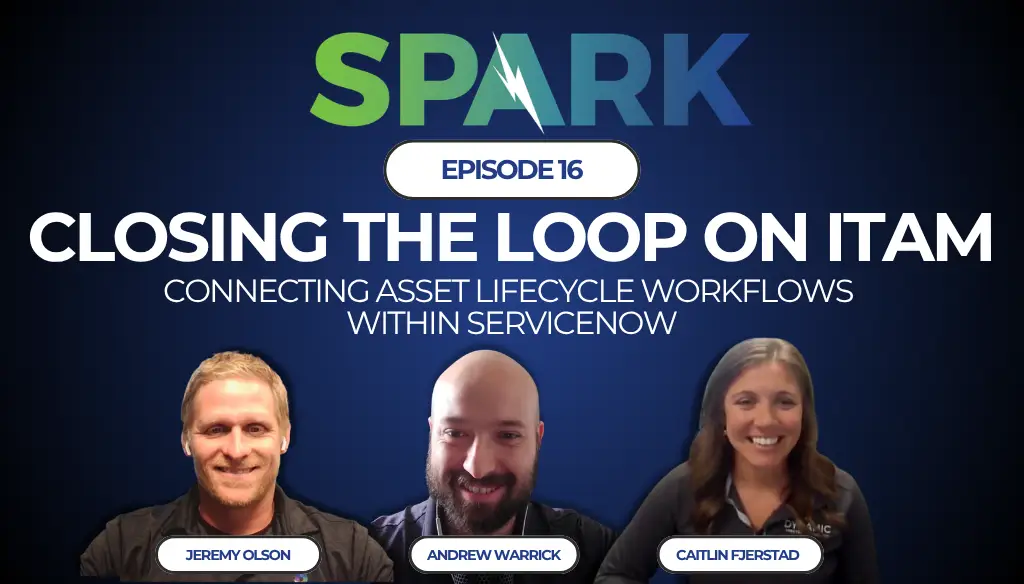
Closing the Loop on IT Asset Management in ServiceNow
In this episode of the Spark Podcast, we explore how integrating IT asset disposition into ServiceNow can help organizations reduce manual processes, improve asset visibility, and create a more connected lifecycle management program.
Joining us are Jeremy Olson, Senior Corporate Solutions Executive at Dynamic Lifecycle Innovations, and Andrew Warrick, ServiceNow Developer at RapDev, who led development of the Dynamic ServiceNow application.
Together they discuss:
- Why disconnected IT asset workflows create operational challenges
- How automation improves data accuracy and visibility
- The role of ServiceNow in modern IT asset management
- Lessons learned while building the integration
- Future trends in workflow automation and AI within the ServiceNow ecosystem
Whether you’re responsible for IT asset management, procurement, or enterprise technology operations, this conversation provides practical insights into modernizing asset lifecycle workflows.
Featuring guest Andrew Warrick, lead developer at RapDev, Jeremy Olson, Senior ITAD Solutions Executive at Dynamic Lifecycle Innovations and Caitlin Fjerstad from Dynamic Lifecycle Innovations
View Full Podcast Transcript
Welcome back everyone to another episode of the Spark Podcast hosted by Dynamic Lifecycle Innovations. On the Spark Podcast, we aim to help organizations get the most value out of their IT and lifecycle programs. In this episode, we’ll be exploring how integrating IT asset disposition into ServiceNow helps organizations simplify operations, improve data accuracy, and gain greater visibility into assets.
From deployment all the way through final disposition. We’ll be discussing both the business case for this approach and provide a high-level overview of the technical capabilities that make it all possible. With me today are two guests. So we have Andrew Warrick He is the ServiceNow developer with Rapdev, and he was the lead on the Dynamic ServiceNow app development. So welcome, Andrew. So great to have you on today.
Andrew Warrick (01:10)
Thank you, it’s my pleasure.
Caitlin Fjerstad (01:12)
We also have with us Jeremy Olsen. Jeremy is the senior corporate solutions executive at Dynamic, and he is bringing with him over fifteen years of experience in the ITAD industry and has a wealth of knowledge about what goes on within the industry. So thank you, Jeremy, for joining us today also.
Jeremy Olson (01:29)
Yeah, great to be on the Spark podcast again and looking forward to t today’s discussion.
Caitlin Fjerstad (01:34)
Wonderful. Well, as we kick things off, really learning a little bit more about the ServiceNow app and that connection point for organizations to monitor that IT asset disposition within ServiceNow. I’m gonna ask each of you guys this first question. And if you can explain what the new ServiceNow app from Dynamic does, maybe at a high level overview, because we’ll dig in a little bit deeper, but a high level overview of what that ServiceNow app does. ⁓ Andrew, we’ll start with you if that’s okay.
Andrew Warrick (02:03)
Yeah,
sure thing. So yeah, so the Dynamic Service App ServiceNow app is basically just a way of integrating between any ServiceNow partners who might be interested in partnering with Dynamic and integrating their system with Dynamics third party system, which is housed in Razer ERP, so that they can get regular updates from the platform. They can have their asset status is updated ⁓ once the ⁓ certification process is complete.
have certificate of disposals uploaded to the platform and just have general ⁓ up to date statuses of where their assets live.
Caitlin Fjerstad (02:42)
Wonderful. Thank you for going over that. ⁓ Jeremy, from your lens, how would you describe the app interaction with customer service now instance?
Jeremy Olson (02:51)
I kind of summarize it is as automating the IT asset disposal process within ServiceNow. ⁓ we’ve taken feedback from several several of our clients over the years on, they’re using disparate systems, client portals, internal software programs to be able to manage the data coming from their IT disposal vendor into their
into their organization and then into ServiceNow. So really trying to, cut out any of those inefficient systems and be able to, house a majority of the process within ServiceNow ⁓ is really a big step in the right direction, the way from where I see it as far as the conversations I’ve had with our clients. So not only is it compatible with ServiceNow ITSM and ham pro versions, ⁓ but clients will be able to ⁓ produce pickup requests from their ServiceNow instead of a separate client portal.
⁓ also information within their service now instance will be pulled from our ERP system as close to real time as possible. So they’re getting that data accuracy, reducing the labor and the resources needed to have to, previously manipulate that data. It’s all coming through ⁓ streamlined in real time and you know, really, really excited about the last thing I’ll say is we we expect this to be iterative. So continuing to talk with clients, prospective clients, and industry leaders on how we can evolve this app and make it better and more powerful.
for our clients long term is is the end goal.
Caitlin Fjerstad (04:13)
Yeah. That’s awesome. Thank you both for going over that just as a kickoff to everything that we’re gonna be diving into. It’s really great from the different perspectives how we see this app ⁓ really coming to fruition, how it was developed and how it’s gonna be able to support organizations. And so appreciate that. next question that we’re gonna ask here is probably more for you, Andrew. When dynamic approach wrap dev
and your team, what was really the business problem that you were asked to solve within ServiceNow? How did that come about?
Andrew Warrick (04:44)
Right. Yeah. I mean a lot of it really ties back into some of the things that Jeremy said, where you have a lot of customers ⁓ for Dynamic who have ServiceNow instances, but there’s really no connection point between the two, or if there is, there’s some unnecessary middlemen or some kind of custom customization that they’ve done within their ServiceNow platform. And there’s not really a standardized approach between linking the two together. And that results in discrepancies, ⁓ both in
what the the customer is thinks it’s sending versus what you receive. And also ⁓ discrepancies between what was updated on the ⁓ dynamic lifecycle ERP end versus what they see in ServiceNow. And that could just be a matter of like poor manual entry on the Service Now side, easy the to fat finger things if you’re doing everything’s by hand or ⁓ or or anything really that that would or really any disruption between the link between the two platforms can can cause that kind of issue. ⁓ so we were just tasked with
Let’s have a standardized way where any customer who has service now, whether they have ham pro, whether they just have the baseline ITSM asset management system, they can download this app and they can immediately within 30 minutes, if if everything goes well, get connected with the dynamic lifecycle ERP platform, begin sending orders to them, track the assets that they’re sending over, and ⁓ schedule the frequency that they want to get updates from ⁓ ERP.
Caitlin Fjerstad (06:09)
Yeah, that’s wonderful. And ⁓ we’re gonna be diving in on the visibility piece a little bit more here in a bit. But yeah, having that visibility real time. And as you said, it’s really thirty minutes roughly to to get it all started and kicked off. And obviously our support team assists us with that if there are any ⁓ concerns or issues or anything, but that’s fantastic. It really helps just enhance that process and streamlines us a lot more. So thank you.
Andrew Warrick (06:34)
Absolutely.
Caitlin Fjerstad (06:35)
Jeremy, from your end, ⁓ you kind of touched on a little bit of the the purpose ahead of timer already, but what was really happening in the market that you felt like made this worth addressing and made the exploration something that we wanted to do on the dynamic side?
Jeremy Olson (06:51)
Yeah, I think that’s a great question. ⁓ from probably over the last three years, it’s really been two major market signals that, I’ve kept hearing from both clients, prospective clients, and just at conferences and various publications. And, those two signals, mainly the number one was when we were onboarding new tier one clients, Fortune large footprints of ⁓ IT equipment to be disposed of and to be managed.
They had already had some sort of integration in place. Might not been might not have been an app, but it was some sort of integration with their previous vendor. And, sort of par for the course, in order for us to do business with them, we needed to have that integration capability. And so we continued to hear that. We obviously had an integration capability prior to the ServiceNow app. ⁓ but the more conversations we had, ServiceNow is really takes on the lion’s share of the market when it comes to hardware asset management. And so,
lowering that barrier to entry by creating this app, which makes it very easy for organizations ⁓ to, I guess, put their stamp of approval on, made it really clear to us to at least begin the evaluation of development. I would say the second is, from my perspective and working with, clients and even just having prospective conversations over the last 15 years is, and I think most ITAM organizations can agree, is they have very minimal resources. most of the
IT asset management groups that I’m working with are ⁓ a group of one person who’s managing hardware asset management and sometimes software asset management. So how can we create a easy button, to be able to offload some of the time and resource constraints that that one person or very few people might have in managing the disposal process so they can prioritize different responsibilities within ITAM. And and again, those two signals kind of coming from both ends of the spectrum really made it a a green light goal for us to begin at least
evaluating what it would take to develop an app.
Caitlin Fjerstad (08:43)
Yeah. As you’re describing it, it kind of made me think of, you know, having some type of integration obviously creates a little bit of an easy button, but having something as an app that’s plug and play right away again can take thirty minutes or around that to activate is kind of making that easy button even easier for organizations to implement and and on their workload and their team. So that’s fantastic.
Jeremy Olson (09:01)
Mm-hmm.
Yeah, and that’s a really great point. I mean, I can kind of expand on that too, and the fact that, when you have your own in house integration, corporations and enterprises, they get information security teams, cybersecurity teams involved. Everybody’s kind of fine tooth combing what that integration is going to ⁓ encompass as far as accessing data in their systems. But once you already have service now in place and you create an app within that app store, it really alleviates some of that ⁓
I guess eyebrow raising from our corporate clients, information and cybersecurity teams, through their they’ve already vetted ServiceNow as, you know, a software for their organization. So having that app just inc just makes that barrier to entry a little bit easier.
Caitlin Fjerstad (09:42)
Absolutely.
Yeah.
And as you’re talking about that, Jeremy, obviously organizations, if they’re already utilizing ServiceNow, either through ITSM or ham pro, that it’s it’s easier. That’s already something and this is just essentially an an add on there. ⁓ Andrew, question for you on that was this the first type of asset disposal app that you’ve helped create or what were the nuances potentially in the IT industry that
maybe made it a little bit easier or made it a little bit more of a challenge and how you overcame that if there were challenges.
Andrew Warrick (10:18)
Right. Yeah. So I’ve done a number of different ITAD related ServiceNow development work, including things that involved ⁓ asset disposal ⁓ in particular. the app development situation is actually a little bit more niche. Usually you’re working directly on a customer’s instance. so yeah, there are a lot of factors that are unique to app store submission, ⁓ including just from a technical perspective, what things ServiceNow wants you to use ⁓ script-wise, if you’re gonna push it to a lot of different platforms.
⁓ and I I I would say that the biggest challenge has to do with it having to be able to handle customers with completely different environments and with different plugins installed in them. ⁓ again, we’ve we’ve mentioned that there’s the ITSM asset management, which is kind of baseline, which is really just a list of your ⁓ your assets that you have in inventory. But ServiceNow off also offers a ham pro version of the same tool, which already has its own disposable lifecycle tool built into it.
So the challenge was really developing something that can take a customer environment with just that baseline asset table or take a customer who’s already has that ham pro disposal ⁓ workflow that they’re using in ServiceNow and to be able to add on to that without taking away any of the value that they previously had in that tool. I would say that was that was the most unique ⁓ challenge, but I’m confident that our app has ⁓ addressed that. It’s able to ⁓ serve customers whether or not they have a mature or immature.
Caitlin Fjerstad (11:28)
Right.
Andrew Warrick (11:46)
asset management and the current state and helped them get to that to that next step.
Caitlin Fjerstad (11:52)
That’s fantastic. And nice to hear that it can help them get to that next step because I think that’s something where Jeremy alluded to. Sometimes these teams are really small. So anything that we can do to help make it a little bit easier for them, taking it to that next level so they can focus on, you know, other responsibilities. ⁓ that’s that’s our goal here too, is to always make it a little bit more seamless for them. So that’s fantastic that the app is also going to address that.
Jeremy Olson (12:05)
Okay.
Andrew Warrick (12:15)
Right, absolutely. And and the first step of that, I think, for many of them is just having that ⁓ automation piece built into it. Not just going through a spreadsheet and re uploading it. it it encourages them to actually use the assets that are in their ServiceNow inventory. And if they do so and they have and they’ve opted in for automatic updates, then ServiceNow will take care of the rest and putting that asset to the right state and they’ll really start to see the benefit of having ⁓ a a mature and and streamlined asset management process.
Caitlin Fjerstad (12:22)
Mm-hmm.
So thinking about challenges too and how we got to the point of creating this app with the support of Rapdev, Jeremy, from your lens, and maybe it’s on the spreadsheet side of you know downloading and re-uploading in different locations, but if you can either expand on that or something else in terms of what some of the complexities that organizations face are, that dynamic was working to try to improve.
Jeremy Olson (13:09)
Yeah, and I I think that I could boil that down and summarize it into two core challenges or complexities, that being time and accuracy. So, we previously, a few minutes ago we just talked about time. We’re working ITAM organizations or IT asset management groups are really teams of one or two people managing, deployment hardware lifecycle throughout the organization. And then they also have to find time to manage the disposal process, which
know, can take up a good amount of bandwidth. And so, being able to have an application that promotes more time back to them and which they can spend to do other hardware or software asset management related tasks. I mean it’s a win win. ⁓ the other thing I’ll say is from an accuracy standpoint, I think any organization, if you ask them, would say we want a hundred percent accuracy of where our active assets are, where our retired assets are, what was done with our retired assets. And so, I think that
the hundred percent accuracy sometimes can be ⁓ put on a pedestal, kind of the ⁓ I don’t know, unachievable ⁓ statistic, but I think it’s a goal that they all strive for. And if we can be part of part in if we can take a a part of supporting them and achieving that goal and kind of closing out the gap of disposal, being a contributor to to taking away from that hundred percent accuracy, I mean in it’s one hundred percent validation that this app is is going to help with that.
Caitlin Fjerstad (14:30)
Yeah.
Jeremy Olson (14:34)
when you when you have more accuracy with what’s going on with your assets, whether they’re being retired and recycled or retired and resold, that significantly helps with internal and external compliance audits and software audits. And so it has systemic benefits, even outside of of accuracy within the organization.
Caitlin Fjerstad (14:53)
Yeah. And thinking about that too, when we’re looking especially with larger enterprises that probably have complex asset management systems within ServiceNow specifically, right? Andrew, you mentioned it, they’re probably using other parts of ServiceNow. So it’s just integrating the disposition part into that. It’s kind of that final link to connecting the full life cycle.
Traditionally, maybe there hasn’t been as much visibility on the disposition part of it because they’re very focused on the the rest of that life cycle. Jeremy, why would why do you think the disposition process hasn’t historically gotten as much visibility as it needs in order to maintain that hundred percent accuracy throughout the entire life cycle, including disposition?
Jeremy Olson (15:35)
Yeah, I think it’s really the pers the perspective of return on investment. ⁓ so when we look at new assets being deployed into the organization, they have tangible revenue generation that they can tie to those assets. Those assets are being deployed, they were purchased. This is the money they’re making for the organization based on ⁓ the user’s role and responsibilities. but then when you look at disposal, the revenue generated from disposal is pretty nominal in the grand scheme of grand scheme of things, especially
as when you compare it to the revenue that active assets are generating. So I really think that, the visibility, and it’s starting to shift. I don’t I don’t think it’s going to be something that happens overnight. ⁓ but really shifting that perception of ROI as it relates to disposal from what it protects the organization from that has a monetary impact. And what I mean by that is, environmental lawsuits, so improper disposal of equipment, ⁓ compliance audit violations.
⁓ and different different types of that, not to mention ⁓ data breaches and lawsuits surrounding data breaches. I mean, if you don’t have the right ⁓ ITAD vendor in place doing the right things with your equipment, that ROI component becomes pretty significant ⁓ if things get out of whack and and equipment is is improperly processed. ⁓ so I really believe it’s an ROI ⁓ discussion as it relates to the visibility. Where there’s more ROI, there’s gonna be more visibility.
And where there’s less, there’s not. But I think starting to incorporate some of that fiduciary responsibility that ITAD plays a role in ⁓ starts to just expand on how we view ROI within IT asset management.
Caitlin Fjerstad (17:10)
Yeah. Thanks for reading that. We haven’t touched much on the ROI piece of it, but it’s absolutely part of the whole disposition process that can obviously then be managed through and be more visible through the ServiceNow app and just that connection within their own instance. So yeah, thank you. ⁓ this maybe is more of a question, Andrew, for you. And we talked a little bit on your experience working with other ⁓ ITAD processes and just apps in general that you’ve helped support.
But as you’ve continued to learn over the years about the asset disposition process, what opportunities do you see from an app side now and even into the future to help continue simplifying or automating these processes?
Andrew Warrick (17:51)
Right. Yeah, that’s a great question. And I think part of it and and part of what I think this app helps to do is there are scenarios where the the out-of-the-box flow for the disposal process might be too long for for many customers. There’s it and and that is by design. It’s it’s a it’s supposed to allow for maximum audibility between each stage. but I believe there’s there’s five or six total different states for the ⁓ ham pro disposal flow process.
Our app supports all of those different states, but sometimes within the space of the same day, it might move from ⁓ penny received to ⁓ either ⁓ to to settlement complete or from the the the initial stage ⁓ to the second to last stage. There’s a lot of variation between ⁓ which stage ⁓ a various ticket might ⁓ update to, especially depending on the complexity of the request, how many assets were involved in it.
And one of the things that this app does is allow for transition from any one step to any other future step, even from the first step to the last step if if that scenario occurs, ⁓ which I think is really great for for many customers. It it reduces the amount of manual clicking between the different states if it was a more simple request and allows landing on the the stage that they actually care about, ⁓ with the app itself closing out all those intermediate steps in the process.
Caitlin Fjerstad (19:17)
Yeah, wonderful. No, it’s great to think about. And I mean Jeremy mentioned too this the the app that dynamic has is iterative and can will continue to advance. So hearing some of that of just what we can learn from right now and continue taking forward based on, you know, your experience with the processes, our organization’s feedback, what’s gonna make their lives easier too, and piecing those together for continued enhancements is just great to hear about and continue learning about too.
From a perspective of current organizations, ⁓ Jeremy, question for you: what kind of operational benefits can an organization get from utilizing this app? And have we gotten any initial feedback? have you had any of those conversations with organizations that are currently using it? And maybe specifically for the ServiceNow app that’s above and beyond a traditional API connection, right? Or
customer portal. Having those is fantastic as a starting point, but this is something that’s above and beyond to make your lives even easier. So if you can touch on just the experiences that you’ve had with organizations using this.
Jeremy Olson (20:18)
Sure. Yeah. First thing I’ll say is I really believe that in that integrations ⁓ between ITAD vendors and corporate enterprises are going to be table stakes either now or in the very near future. And, through that, some of the benefits are, we had a large financial ⁓ customer that we recently onboarded. and they were shifting from a from a from a vendor that they had used for almost a decade.
And they had full integrations with that vendor. And in order for them to shift to utilizing dynamic, they needed the same integration capabilities. And so at least being able to meet them at the starting line or the at the one-yard line and say, hey, we have the integration capabilities to do what you need us to do specifically to your organizational needs. that allowed for a really smooth transition, really easy onboarding. And from a service go live, it it, it probably reduced that timeline by, 30, 45 days from what our target was.
⁓ and so that’s a really specific example as it relates to just having an integration capability. but when we talk about having a ServiceNow application, ⁓ from my standpoint, when we talk about Service Go Live and being able to transition from one vendor to the next, it only expedites that even more. As we talked about before, we don’t have necessarily we don’t have all the barriers to entry that the ServiceNow app kind of eliminates because Service Now has already been approved.
Caitlin Fjerstad (21:31)
Yeah.
Jeremy Olson (21:41)
⁓ by various internal security teams for usage. And so when you have an app, there’s somewhat of that already established trust ⁓ that the app is going to work in sync with what they need from within ServiceNow. ⁓ But the other thing I’ll say, as far as operational benefits go is, providing more productivity and efficiency to ITAM teams who are, somewhat understaffed at as we’ve talked about. ⁓ But just creating automation and accuracy through that automation.
especially in the times as we’re talking about AI, I think that the human element has has definitely has a place long term within, various areas of businesses. But when we look at automating data as it enters our system and from our system it goes to ⁓ our client’s system through the app, that accuracy is is really untouchable in my perspective. I think that, when you start taking data out and you manipulate it and then you shift tasks and you come back to it and
Then you’re uploading it back into your ServiceNow instance, we’re not perfect. ⁓ and we get as humans, we get sidetracked and we’re working on different things or trying to multitask, and errors are bound to happen. ⁓ so if we can, make a f a step more seamless through automation and simply just reporting asset data and subset data, and be able to have that pass directly through our ERP to our clients hardware asset management software through ServiceNow.
I think that it only and it only amplifies the accuracy that they’re looking to have long term.
Caitlin Fjerstad (23:04)
Yeah, absolutely. I think that’s fantastic. And it’s great to hear just the experience you’ve already had with some of your clients too, of just their experience and how you said too sometimes it is really difficult to look at potentially changing vendors because of all the system connections. And if this helps to make that process smoother, that’s one less thing you have to worry about if you are considering a change of vendors potentially. ⁓ so thank you for diving in on that.
Okay, next question we have here, what trends are you seeing in other apps, Andrew? And in terms of like the workflow automation, the broader Service Now ecosystem, but what trends are you seeing that organizations should be aware of overall?
Andrew Warrick (23:48)
Yeah, great question. So obviously ServiceNow is a always developing, always improving app. And with that, the apps that are made in the platform have to always be in line with the new advancements that that are coming as well, which I believe our app is is well positioned and it helps to encourage the general trend of of automation, of of ⁓ linking disparate systems together and and just minimizing ⁓ middlemen across the board.
Another thing that plays into that, when this is more of a looking to the future sort of thing, although the first wave of it is being released now, we have the new MCP standard ⁓ that ⁓ ServiceNow is now incorporating with Australia, at least for customers who have ⁓ Now Assist or an AI AI native licensing. that will basically allow ⁓ other external agents and and chatbots and the like to potentially do these the ticket submission for you. So they don’t have have to even necessarily be in the platform.
they can have a an external AI c ⁓ tool that calls into the platform and then leverages the tools that we have, which in in passing, although I think it’s important to mention, the app is is is prepped kind of ⁓ development. It it’s already very modularized in the way that it behaves, so it’d be fairly easy to incorporate into ⁓ MCP ⁓ servers if it will if and when and I I really should say when ⁓ that becomes the more dominant approach that these things take.
Caitlin Fjerstad (25:16)
Yeah. I think that’s really great insights and I appreciate as you were talking about this too, ⁓ if you think to the ServiceNow Knowledge Conference, I think some of those experiences that people are maybe dabbling in and bringing into their different organizations hearing some of those case studies across the board of just different ways that they are utilizing the ServiceNow platform and different apps or modules to enhance their processes and so many different workflows and their whole ServiceNow ecosystem is really fantastic and I think plays into
what you were talking about as well as just one of those additional lovers that they can continue to pull moving into the future. Okay, I’ve got one more question, at least one more question, ⁓ for both of you guys probably. But ⁓ Andrew, we’ll start with you. Are there any key takeaways that you learned from developing this ad? That, excuse me, are there any key takeaways that you learned from developing this app that you’d like to share that we haven’t covered so far?
Andrew Warrick (25:51)
Absolutely.
Caitlin Fjerstad (26:12)
or any advice that you would give to somebody who will look at adding this app as part of their process?
Andrew Warrick (26:19)
Yeah, absolutely. ⁓ yeah, I would just say maximal flexibility and app design is is key. And that’s something that was very much part of this this process. We already mentioned the different plugins and the like and licenses that ServiceNow customers might have. But again, the maturity level matters a lot too. Some customers might not be ready yet to actually draw from their asset inventory w it for some of their assets at least when they’re submitting the the ticket.
And so so we made that app flexible enough to to also just ingest lists of assets too. It will update the things that you have and then give you reports on the things that you you might not have in your system and be able to to add in. And but that’s the way I would encourage customers who who who download and and and use this app to to go towards is once they see the benefits of of what can be automated through the system, ⁓ to to use that as a as an opportunity to begin ⁓ standardizing the the the broader framework and
not just have reports about what you don’t have, but also now see ⁓ I need to add those assets to my system so the next go around we actually can can have better visibility.
Caitlin Fjerstad (27:22)
Okay.
Yeah, wonderful. Thank you. Jeremy, I’ll pass it over to you. Same question. Any key takeaways you learn from the development or any advice that you would give to an organization who’s looking at adding this on.
Jeremy Olson (27:37)
Yeah. I think the key takeaway for me is just the reaffirmation that keeping your finger on the on the pulse of what’s happening in your client’s world is so important. ⁓ trying to stay in constant communication with them on pain points or roadblocks they’re facing within their IT asset management process, specifically rated to related to hardware, but it could be software related as well. ⁓ but then also in turn getting feedback on,
what dynamic is providing and the solutions and services that we have available and getting that key feedback from our clients on, what would you like to see? What would you like changed or modified to better suit your organization? I think it really enables us to, accurately develop solutions that solve real problems and not just create shiny objects that serve no purpose, but just vanity and, maybe they look special and then when you download them, they do nothing. ⁓ and so, for me, my key takeaway was really what
What caused the app to come to fruition was, constant contact with with customers, with prospective clients, getting their feedback and really culminating that into, yeah, this is validation that this this app should should move forward. And, we’re already seeing a lot of interest in some conferences that we’ve talked briefly about the app. we’ve already had a few calls and and just gotten some really positive feedback as to ⁓ the solution the the problems that we knew it was gonna solve and getting that validation.
That it is solving those problems from those clients. So ⁓ yeah, that would probably be my biggest key takeaway. I think, my my ⁓ what I’ll what I’ll leave clients with or organizations that are that are looking to create efficiency within their IT asset management or IT disposal process is, there are solutions out there. ⁓ take a look at at our app on the ServiceNow store. ⁓ we have demos available, but
I would say, overarchingly, whether you are considering Dynamic or any other IT vendor in the market is seek that integration. It will make your life easier.
Caitlin Fjerstad (29:34)
Yeah, wonderful. Thank you for sharing that and thank you both so much for joining today and really talking about the integration possibilities with Service Now and just overall the advancements that you’ve put in place and that you’re continuing to work on moving forward to really help organizations, IT and lifecycle programs that much easier and that much more efficient for them. So appreciate that insight. ⁓ for anybody listening.
Definitely feel free to reach out to either of these individuals, but feel free to reach out to us if you have any questions just on the benefits or any of these technical aspects that were discussed today. And if you want to have a deeper conversation about how that applies to your specific IT program. So really appreciate everybody joining today. Jeremy, Andrew, thank you so much again. It was great having you today. And ⁓ join next time for the Spark podcast. Thank you.
Jeremy Olson (30:27)
Thank you.
Related Resources