What Drives Electronics Recycling Participation? Insights from Michigan Leaders
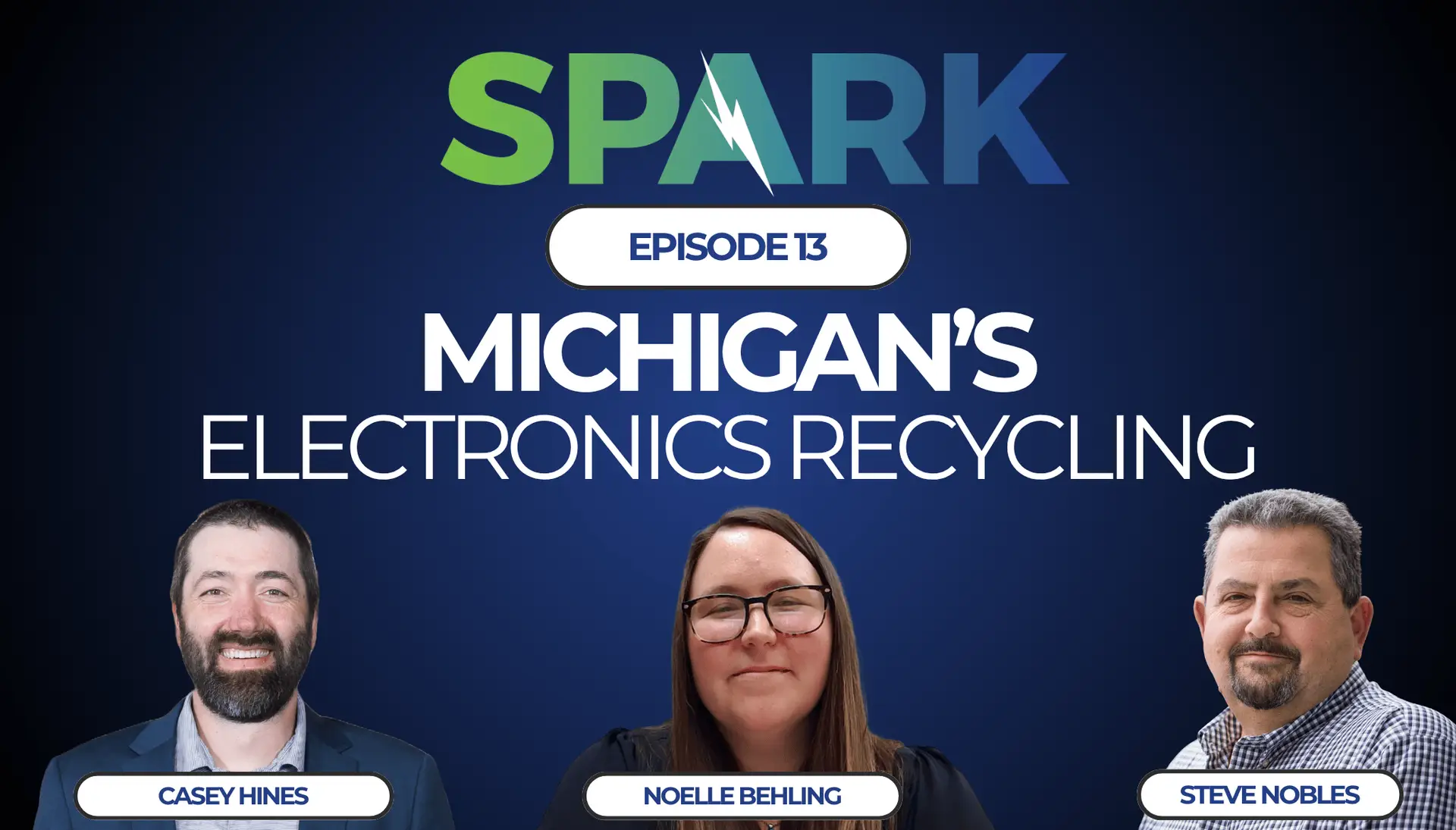
In this episode of the SPARK podcast, Casey Hines sits down with Steve Noble of Michigan’s Department of Environment, Great Lakes, and Energy (EGLE) and Noelle Behling of Emmet County to explore what drives electronics recycling participation.
While most households have unused electronics tucked away in drawers, closets, and basements, turning those devices into recycled materials often depends on more than good intentions. Access, awareness, convenience, trust, and communication all play a role in whether residents choose to recycle.
Drawing from both statewide and local perspectives, Steve and Noelle discuss:
- The current state of electronics recycling across Michigan
- Common barriers that prevent participation
- Why convenience is critical to program success
- How local outreach and education influence resident behavior
- The role partnerships play in expanding access
- Why transparency builds trust in recycling programs
- Practical advice for communities looking to strengthen or launch electronics recycling initiatives
Whether you’re a municipal recycling coordinator, sustainability professional, local government leader, or simply interested in responsible electronics recycling, this conversation offers valuable insights into building programs that drive participation and create lasting community impact.
Featuring guest Darrell Fleming-Kendall, Executive Director of the Global ITAD Alliance and Caitlin Fjerstad from Dynamic Lifecycle Innovations
View Full Podcast Transcript
Welcome back to the Spark podcast from Dynamic, where we break down what really happens with your old tech and what this means for you. I’m your host today, Casey Hines, and we’re talking about something that impacts nearly every household, what to do with unwanted electronics and how communities can make recycling them easier and more accessible for residents. From old TVs to laptops, printers and phones, electronics pile up quickly in our homes. Most communities offer electronics recycling programs.
But participation can vary depending on awareness, convenience, and how confident residents feel about the recycling systems.
The encouraging thing is that when state programs, local governments and recycling partners work together, we often see participation grow and programs become more effective. To talk about what’s working and what communities are learning, I’m joined by two great guests today. Steve Noble from the Michigan Department of Environment, Great Lakes and Energy brings a statewide perspective on electronics, recycling programs and participation trends. And joining us from Emmett County is Noelle Behling Communications and Education Coordinator who works directly with residents to help them understand how and where to recycle their electronics locally. Steve, Noelle thanks for joining me today. Steve, I’d like to start with you and zoom out to the statewide level. From where you sit, what does the current landscape of electronics recycling participation look like across the state of Michigan?
Well, for some that know, we do have an extended producer responsibility law, which helps encourage the manufacturers to provide services for the communities that want to be involved. The challenge is our law is rather weak. And so it doesn’t encourage strong participation by the manufacturers. But I would say from a statewide perspective, there is stronginterest in having collection services across the state. The challenges in the southern third is very easy pickings. There’s a lot of larger communities with more volume. And then as you get farther north in the rural areas, you run into higher expenses and higher costs to get the same amount of material. So the cost is a challenge. And, you know, from a statewide perspective, I think we’re doing a good job with our grant program to help balance that out.
Sure. Now, I know there’s some differences from the northern part of the state compared to the southern part of the state. When it comes to some of the trends of the materials that you’re seeing, are there any trends, for example, northern part of the state maybe generating some of the older CRT televisions at a higher clip than potentially some of the southern part of the state? Or is it pretty consistent across the state?
No, you’re right, Casey. In the rural areas where they don’t have the access to the services or they may be dependent on, you know, once a year pick up events. We do see a lot more CRTs, cathode ray tube, older style TVs. We’ve been doing events in the upper peninsula for four years now, and we’re starting to see a downward trend of the CRTs. I would say we’re down to about 40 % of the weight is CRT weight and the flat panel, the big screens are picking up definitely. So yeah, there’s finally that downward trend in the rural areas of the CRTs.
How about when residents decide whether to recycle something like an old TV or a laptop, what do you see as the most common barrier that sometimes prevents participation and maybe excluding some of the hangups or the barriers that you mentioned earlier? Is it about awareness, convenience, cost, just simply confusion about what can actually be brought in for recycling or what are you hearing?
I would say you hit multiple nails on the head there. I do have the joy of running my own drop-off site in Southern Michigan. So we get a variety of questions about, you know, where does this stuff go? How is it handled? That type of thing. I would say the probably the most common issue is, you know, is my data secure? What do I do to get it ready, you know, to be recycled? A lot of people just, you know, you can tell them, you can give them information. They’re just not comfortable recycling that piece of equipment if it includes data because they’re just not sure. And that fear of their information, even though the computer probably wouldn’t boot up ever again, their fear of having that information get in the wrong hands is really a strong deterrent. We do get a lot of questions. Well, I didn’t know you guys were there. Well, yeah, we’ve been doing this for 20 years.
But, you know, we’re kind of new on the block. And that’s what I like to joke with them is, you know, we’re here every, every Saturday of the month and you’re welcome to drop your stuff off. But, you know, it’s again, it’s, if they’re not thinking along those lines until that point where they stumble on that computer in the basement and want to get rid of it, then it’s, then it’s nothing they’re going to check into
Yeah, yeah, yeah, think certainly knowing where and when to take material.
Another thing that we often hear when it comes to success of recycling programs, it really depends on the collaboration. In your opinion, how important is the participation between state agencies, counties, municipalities, certainly recycling providers, when it comes to expanding the access and participation across the state?
It’s always very beneficial to have. mean, the state can only do so much. You know, we have our hands tied. can’t be, I’m the one that runs the whole program. So I can’t be in 83 counties at once. So it’s always good to have local or state or county partners to help pick up the ball and move forward a little bit. So, you know, it’s beneficial to get the counties involved, especially the localities. Noelle’s from Emmett County. They’ve done a very good job of setting up a permanent collection site. So their area, their region up there has ongoing services. That’s a big issue is if you’re just doing it once a year, then those people have 364 more days before they can find a home for their devices. And that’s just an encouragement to stuff them somewhere else or just not deal with the problem.
Yeah, thank you Steve. The statewide perspective is certainly very helpful and I think that’s kind of a great transition point to switch over to Noelle. I’d love to hear a little bit from you about what’s working directly with residents in Emmett County. So from your experience, what are really the most effective ways to encourage residents to bring in their electronics for recycling?
You know, I found that literally meeting people where they are at one of our 12 public drop sites or at our super drop-off center, I’ll be sorting batteries in the shed and someone will peek into the shed and say, hey, what do I do with this computer monitor? So literally meeting people, being out in the public and being able to share our stories and what we do for everyone and what’s available, have them the most successful outreach.
Yeah, yeah, and I think Steve touched on, you know, maybe hearing from time to time that folks didn’t know that he was there, that they were there collecting materials. What outreach methods have worked the best for you and your program?
Well, we try to use all of the channels for outreach. So we use our social media platforms, our website, local newspapers. We have good relationships with our media for TV. We use our local library, our local college. So we’re using all of the things available to us as much as possible.
Sure. And I imagine from maybe a weight perspective, weights have gone down over time. But as far as like a participation rate, would you say that has grown over time?
You know, I actually looked up some of our data. I’m a data nerd. Um, so in 2019, we were around 88,000 pounds a year and consistently since then we’re around 115,000. 2020 took like a big turn. had an additional 50,000 pounds. think everyone was at home and, um, cleaning out. So we’re, consistently around the 115,000 pounds. We are a hub. So not only is our County bringing, um, electronics to our site, but other communities, um, outside of county. So, I think we’re getting there with electronics recycling. But yeah, our data is staying about the same now.
Okay, now when you’re communicating with residents, what types of messaging really tends to resonate the most? with your folks?
That’s a good question. So I found what we call the empathetic message, like saying, yes, it’s confusing. Yes, it’s hard to find the information. And here’s what we can do to help you find the right location and the right strategy to remove those items from your home safely instead of using the easy way of throwing things away, which as we know, is not wonderful.
Correct. What about like maybe the environmental benefits, protecting personal data that Steve kind of touched on earlier, convenience of the program, community pride and doing the right thing. I think you mentioned obviously keeping things out of the landfill is certainly important. Any of those other ones hit home in your community as well?
I would have to agree that all of those reasons really hit home. We live in such a supportive community up here in the tip of the Mitt Everyone is very concerned about taking care of our environment and being able to stay and play here. So we want to do the right thing, keep the hazardous materials out of the watershed, out of the landfill. Don’t want any those battery fires. So everyone’s interested. We all have the same goal, regardless of motivation.
Yeah. Now, how important are those community partnerships when it comes to building awareness and participation within the county?
it’s so key and actually have a really great story I was hoping to share. Our communities, a lot of them host a spring cleanup where you can put things at the curb for disposal. We have a local high school robotics team that we partnered with. I have to back up just a little bit. So every municipality hosts either a spring cleanup where you can put things at the curb or they have a voucher they can use at our facility. One of the items that the city doesn’t want you to put out at the curb are electronics. And our local robotics team, we gave them a voucher to use and they pulled the electronics from the curb so that the right thing was happening instead of them going to the landfill. So those community partnerships are so important to get the messaging out, get everyone doing the right thing. So that’s what I love about our small community is that we can have those relationships and these ideas can come to fruition.
Noelle, sticking with your perspective, how important is it for communities to help residents understand how electronics are handled responsibly after collection?
Incredibly important. We have a real recycling promise here in Emmett County. We publish all of our end markets so that people have the confidence in our program and our end market partners so that they know the right thing is happening with all of their recyclables, including and especially electronics.
Thank you for sharing that, Noelle. Steve, how about from your perspective? Are there any examples that maybe you’d like to share?
I do. As I mentioned, we do have a drop off site here in my community. We have a local industry that in the last year or two has taken some interest in providing services for the community. So they each Earth Day, they sponsor a free electronics collection event and we found that it’s really helpful to hear it from a different source. So they use their social media outlets, they use some other outlets that they have to get the information out about other recycling opportunities. They actually sponsor three days each summer. They call them free recycling days and it’s not only just electronics but you know batteries and other material that can come in and it’s nice to see the success as the information comes from a different source. So sometimes, you know, it’s they’re hearing it from us all the time, but you hear it from somebody different and you get a different result.
Yeah, absolutely. That’s great to hear and thank you for sharing that. Noelle, I want to jump back to you and I want to just touch on something that Steve had mentioned a little bit earlier and that’s bringing up some of the concerns when we’re looking at data security. How big of a role do those concerns play when residents are deciding whether to recycle electronics in your opinion?
They play a huge role. think we get that question several times a week, whether on the phone or when we’re physically at our site collecting. People always want to know, what happens afterwards. And I love that I can say beyond a shadow of a doubt that your data is secure. We only go to bid and use companies that have the highest certifications that we know your data is safe. And they love that. And I love that I can share that and have no qualms.
Yeah, yeah, think having that peace of mind and knowing where you’re sending that stuff is certainly important for everybody throughout the chain. So it’s great to hear, Now, I kind of want to pivot again, really just looking at designing programs that work for your community. We’ll start with Steve from the state perspective. How important is access and convenience when designing electronics recycling programs?
Casey, I think it’s one of the key things that we have to deal with. The state has been working for a couple of years now to set up what we call hub and spoke models, because not every community has the ability to collect, you know, a box truck full of electronics. They may collect all summer and only get three or four boxes of material. So we’ve been working really hard in the rural areas with some of the local vendors to have them do milk runs and go around and pick up three or four boxes and then bring them back to a consolidation point. And it’s, we found that that’s worked quite well. Again, it’s that cooperative effort like Noelle was talking about with their system.
We’ve been reaching out to some other areas to do the same thing.
Yeah, yeah, yeah, I know. Noelle, I believe your program allows for year-round drop off. Is that correct?
It is. We previously had special collection events and that seemed a little confusing for people, what they could bring and when. So when we moved to having six days a week collection that just simplified everything, you know, we pride ourselves on being comprehensive, cost-effective and convenient. And I think that convenient piece really drives a lot of people to do the right thing with their electronics when they have that option.
Sure. And how about looking ahead? What do you think communities can do to make electronics recycling even easier or more accessible for residents?
I think partnering with the state, with other companies, programs that have like-minded goals, I think that would be a great thing for communities to do. It’s okay to start small, it doesn’t have to be big from the get-go.
Yeah, yeah, absolutely. Steve, I’d love to hear the state’s perspective as well.
Again, it’s cooperative efforts, providing convenience. We’re only going to see the amount of electronic stuff grow because we’re turning into an electronic world. people want to do the right thing with their old electronics. know, used to be some of those cathode ray tube TVs would last 15, 20, 30 years. You know, I had an old Sony that was still working when I sent her to the recycle yard. But some of this new stuff, you know, you get a year or two or three out of it. You know, we’re going to see more and more need for recycling. as Noelle said, people want convenient access. Once a year, I don’t see that being, you know, accessible to people because they, like I said, you got to go 364 more days to find that access again. So let’s work cooperatively, and work on regional efforts. The state is always looking to help people that want to do regional efforts, we’re more likely to send grants to communities that are doing a regional effort than it is to somebody that just wants to stand alone.
Sure. Now, how about in five to 10 years, where do you see the Michigan program? You’re kind of looking into the future, getting out your magic eight ball. How do you see, or how do you hope the state may evolve over those next five or 10 years?
I would hope that the state continues its grant program. We’re looking at a couple tight fiscal years because of some of the stuff going on at the federal level. But I think there’s other ways. The state’s entering into what’s called the material management planning process. And I think that’s going to raise awareness in every county of the state that they need to set up some kind of electronics recycling and recycling.
batteries and other materials that are people are now disposing of in the landfill. So I think the state needs to help step up and provide not only supportive funding, you know, it’s not necessarily going to be, we’re going to fund you for five years, but we’re going to get your program up and running. And then you’ve got to take it from there. So
I think that’s going to be the key over the next several years is getting that support out there so people can stand up and move forward and provide those services that their residents are going to want.
Yeah, yeah, kind of, you know, providing one of the common themes we’ve been talking about, which is just excessive.
That’s very cool to hear. Noelle, how about for you, for counties or communities listening today that may be trying to just improve their programs or even get one off the ground, kind of like what Steve’s saying, the state is going to be trying to help support. What are two or three lessons that you’ve learned over your time that could help them really get started?
Yeah, I think as I mentioned before, starting small is okay and finding those partnerships like with the state or your local community fund for dollars to start your program.
As Steve also mentioned, Michigan specifically is in the throes of materials management planning. So, including those goals in your plan and building those local partnerships. I really think that those are very important and that’s a hyper local thing that you can do to start small and improve your program.
Yeah, that’s a great suggestion. All right, well, both of you obviously have been in the industry for a while and know what you guys are talking about. So just wanted to kind of go through kind of a quick reality check, just to have a couple of questions for you guys and just see what you’re both seeing through the recycling chains. First, Steve, what’s maybe the most commonly recycled electronic item that you’re seeing?
It’s going to have to be televisions. There’s just an awful lot of them out there. And like I said, they’re not lasting like they used to last. And so we’re seeing an awful lot of televisions coming back in.
Sure. Noelle, I assume you would agree there?
I do – TVs and monitors for sure.
Yeah. Noelle, how about what’s one of the most surprising items that someone has brought into your program for recycling?
Well, if we’re talking about things we found in the electronics recycling shed, we had what looked like a World War II, some sort of a device from an airplane show up in our electronics shed. It ended up being a little bit of radioactive device there, so it was a little expensive to dispose of with our hazardous waste, but I can see why they thought it was an electronic item.
Sure, that’s interesting and scary at the same time. And Steve, absolutely, that’s good to see that they’re doing that at least. And Steve, I imagine with you having a lot of contact with the different programs across the state, I’m sure you’ve heard of some surprising items as well.
Yeah, actually one came into my recycling site about a year ago. It was a TV that was old enough that it only had one dial on it. It was in a little metal box. Actually, the guy, you could tell it had lived most of its life in his barn because of all the debris on it. it was like, you know, it’s about, I don’t know, 13 inches and the
The box is the screen and it’s got one little dial in the corner. So it’s like, I turned it over to look for a date on it, but I couldn’t find it. But you could tell it was one of the first ones ever made.
Very cool. How about one item that residents should never throw in the trash? Steve, we’ll start with you if you don’t mind.
Well, since it’s the other half of my life, I would say lithium batteries. And it’s a challenge. Noelle will admit to this, getting people educated on what a lithium battery is. I think they just think a battery is a battery is a battery, and they don’t know the difference.
But yeah, that’s going to be the big challenge moving forward is how to deal with lithium batteries. I got a call this morning from somebody that was charging their cell phone over the weekend and now all of a sudden, it’s puffed up and it was just like, you know, thank God it didn’t go to the next step. So, they wanted to know how to get rid of it.
Yeah, well good. It’s always good to hear that they’re at least calling in and trying to handle those batteries the right way. Noelle, how about you? What’s one item that you feel residents should never be throwing in the
I have to echo Steve. I was thinking battery embedded devices, which are generally lithium batteries. It’s so hard to identify some of those sneaky ones that are in your key fob or in your kids light up shoes. so those are definitely the things that we come across and I don’t want them in the trash. We don’t want any more fires. So I have to echo Steve.
Yeah, absolutely. I know all our haulers would be echoing this as well and certainly thanking you both for mentioning those. Yes, so this has been really insightful discussion.
It’s clear that increasing electronics recycling participation isn’t just about programs. It’s about making recycling accessible, communicating clearly with residents, and building trusted partnerships between communities and responsible recycling organizations. Steve and Noelle, thank you both for sharing your perspective and the work you’re doing to help communities recycle electronics responsibly. But before we wrap up, one final question for each of you.
What’s one simple action residents can take today to make sure their electronics are recycled responsibly? And Noelle, I’d like to start with you at the county level.
I’d have to say do some research or give us a call and that can go to any of your local community governments or whoever is doing the recycling in your area. Just make that call, ask the questions.
Yeah. Steve, how about you?
I see an awful lot of. you know, fly by night recyclers and just, you know, ask the question. If you’re dropping something off, you know, ask them, where does this go? How do you handle it? You know, cause there’s an awful lot of people that, you know, they’ll take in an old TV, be happy to charge you $10 or $20. And then as soon as you drive away, it’s going in the dumpster. So it’s not getting recycled. So ask the question and you know, don’t be afraid to push them a little bit. You know if they’re hemming and hawing then maybe that’s your answer that they don’t really want to tell you where it goes but we like to say responsible recycling is the best.
Thanks again to Steve Noble and Noelle Baling for joining the conversation today. And thank you to everyone listening to the Spark podcast. If you found this episode helpful, consider sharing it with a colleague or community leader working to expand responsible electronics recycling in their communities. And we’ll see you next time.
Related Resources