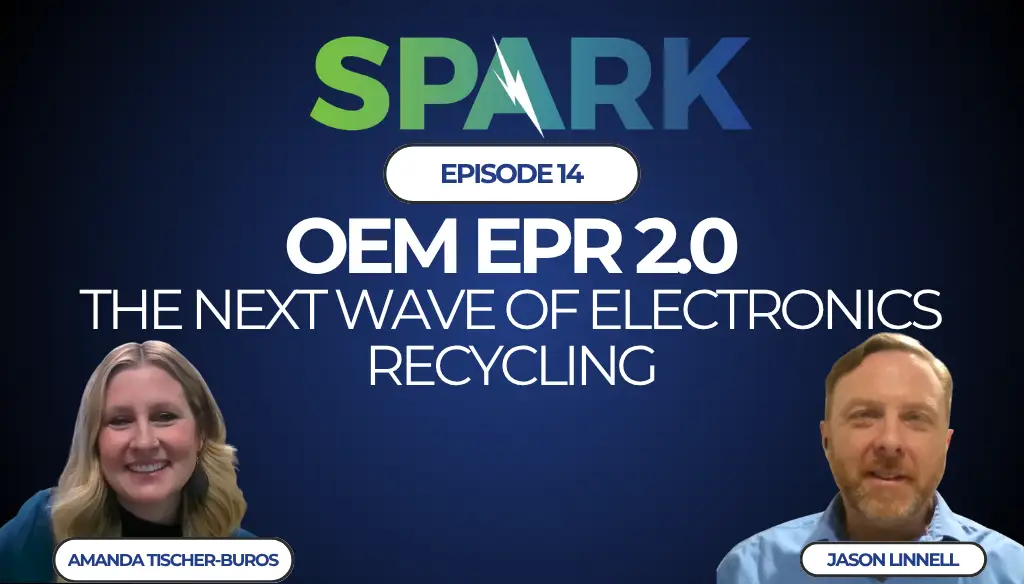
EPR 2.0: What OEMs Need to Know About the Next Wave of Electronics Legislation
What does the next generation of electronics EPR legislation mean for OEMs?
In this episode of the Dynamic SPARK Podcast, host Amanda Buros is joined by Jason Linnell, Executive Director of the National Center for Electronics Recycling (NCER), for a deep dive into the evolving landscape of Extended Producer Responsibility (EPR) programs across the U.S. and beyond.
Together, they explore:
- Major shifts in electronics EPR legislation
- State-by-state program evolution and fragmentation
- Product expansion trends in states like Wisconsin and Illinois
- How OEMs can manage rising compliance and operational complexity
- Cost forecasting and financial planning considerations
- The growing role of circularity, batteries, and critical materials recovery
- What U.S. programs can learn from Ontario’s evolving framework
- How recycling and service partnerships are becoming more strategic
Whether you’re leading sustainability, compliance, operations, or product stewardship efforts, this episode offers practical insights into where electronics legislation is heading — and how OEMs can stay ahead of it.
Tune in for expert perspectives on the future of electronics recycling compliance and the operational strategies organizations should be thinking about now.
Featuring guest Jason Linnell, Director of the National Center for Electronics Recycling (NCER), and Amanda Buros from Dynamic Lifecycle Innovations
View Full Podcast Transcript
Amanda Buros (00:03)
Hi and welcome to the Dynamic Spark podcast, where we break down what really happens with your old tech and what this means for you. I’m your host, Amanda Tisha Burris, Vice President of Recycling, Sales and Corporate Responsibility. And today we’re diving into Extended Producer Responsibility or EPR programs. So if you’re an OEM leader responsible for EPR compliance, this conversation is definitely for you. I’m excited today to be joined by Jason Lanell, the Executive Director of the National Center for Electronics Recycling.
Jason leads activities such as research on electronics recycling, data and policy, and management of the Electronics Recycling Coordination Clearinghouse, or ERCC. Under Jason’s direction, NCER manages and oversees the statewide networks of collectors and recyclers for the Oregon State Contractor Program, the Vermont State Standard Plan, and administers Illinois and South Carolina manufacturer clearinghouses. Let’s get started.
As many of our listeners know, there are currently 26 electronics extended producer responsibility programs, or EPR programs, in the US, spanning 25 states and the District of Columbia. Today we’re going to take a high level look at those programs alongside Ontario, Canada, and explore that patchwork framework, key trends, and what matters most for OEMs navigating it all. So EPR for electronics has been around for a while, but what we’re seeing right now feels a little bit different. there’s a little bit more activity, more complexity, and maybe some more pressure on producers to keep up across multiple states. Jason, from your vantage point at NCER, we used to start by giving our listeners some background in electronics EPR, maybe take us from where we started to where we are today and how EPR is gaining traction in some other areas.
Jason Linnell (01:46)
Yes, sure. And first of all, thanks for having me on. I’m excited to talk about these topics. It’s something that we deal with at NCER all the time. And it’s good that it is getting more attention these days because, as you said, electronic EPR has been around for a long time. It started almost 20 years ago, back when ⁓ NCER was first formed back in 2005. We started having electronics recycling laws at the state level all over. It started with, actually Maine was the first
state with an electronics EPR law back in 2006. And since then, we’ve had a number of states getting up to that 26 level, but most of the activity was focused in the 2007 to 2010 range, where we had just six, seven, eight states in a row, all in one year pass new legislation that mandated some type of electronics extended producer responsibility. Now, they are all very different. And I’m sure we’ll get into some of those differences and how those are evolving over time, but the states did pass in that sequence. But since that time frame, since about 2010, I guess I’d say 2014 was the last new state law, if you call the District of Columbia, the last ordinance that passed and added to our list of 26. We haven’t had a lot of activity as far as new states passing laws. We do have, so that is about half of the states, obviously in the country and about two thirds of the US population covered by those laws.
But since 2014, there’s been a lot less activity in terms of new states adding laws. What they are doing is modifying or amending their laws, adding new products, changing how the manufacturers interact with the program, their requirements, and just in general, the types of collection programs that are being offered under those state laws. So we do see an evolving state programs. We do see some influence from some of the other products that are out there because it’s not happening in a vacuum.
There are other products and other industries that are being impacted by EPR and that’s where a lot of the activity is happening today, especially with some of the newer laws on packaging. Those are really coming into effect. It’s a big program, involves a massive number of industries and manufacturers in those programs and it follows along with other industries that have had programs like in paint, like in mattresses, like in batteries and they have been doing some form of EPR for many years. So it’s an exciting time. There’s a lot happening with electronics, but we do also have to keep in context the other things happening in the other industries as well.
Amanda Buros (04:26)
Yeah, that’s great. Thank you for kind of painting that picture for us and giving us sort of that historical oversight. So as you look at EPR right now, what are the biggest shifts that you’ve seen in the last 12 to 18 months? And what are the things we should be paying attention to?
Jason Linnell (04:42)
Yeah, so those changes that we’ve seen in the last year, year and a half like that are the products being expanded. So there are states like Oregon, Hawaii and Wisconsin that have modified what can be accepted. And so for a manufacturer, that means you have to know what the products are that you’re selling that could be potentially impacted by these laws. And once you think you know that they could change, they could be expanded. So the state could add in a new requirement for those new types of devices that are being sold or new product categories that weren’t previously covered. So those things are changing. then the biggest change, I guess, that have come into effect is in the Oregon program. The Oregon program underwent a pretty big change that they passed back in 2022, but it’s just coming into effect now. Where the overall structure of the program has changed, there’s a producer responsibility organization running the entire system. We were involved in the Oregon State Contractor Program since it was in the beginning and now that program has ended as of 2026. So there’s some changes there that we’re keeping track of and that everyone should be on top of and we want to see how that impacts some of the other changes that might happen in other states going forward.
Amanda Buros (05:56)
Yeah, great. That’s great insight. So as you talked about, we are seeing some momentum, maybe not in the form of brand new laws, but an evolution in the laws that exist across the US. It’s not always obvious for all of us in the programs or working maybe adjacent to these programs to understand what’s driving those changes or where it’s headed. So looking at the national level, what are the biggest trends you’re seeing in electronics EPR right now or EPR outside of electronics?
Jason Linnell (06:28)
Well, I guess the biggest thing we should say is that there is no push for national electronics EPR law. That is something that would have to come through Congress. can’t just be done through EPA. And we really haven’t seen that activity happen for going back to the history of these state programs. But outside of that, there are some factors influencing what’s happening with electronics EPR at the state level. guess I’d say nationally, one thing would be the interest in critical material recovery. So there’s certain critical minerals, critical materials however the terms you want to use that are in electronics and ⁓ recycling is viewed as one way of capturing those keeping those in the US keeping those in North America for recovery rather than having to rely on sources of those being mined in other countries and being faced with supply shortages. So that’s impacting some interest in increasing recycling programs on a national level. Just the general push for circularity and having manufacturers look at how they can incorporate more materials into their products that are being used, repurposed from recycled materials. And then the push, as we mentioned, for more packaging programs. when we talk about packaging, it’s really your plastic bottles, your paper, your things that have been traditionally recycled. And now there’s a new push at the state level to have those caught up in a new type of EPR approach. And there’s several states like Oregon, California is on the board, Maine, Colorado, several different states that have passed laws. More of them are looking at laws. And there’s a whole new entity for the industry called the Circular Action Alliance, a new PRO that has been developed that a lot of electronics manufacturers are probably having to be involved in as well from the packaging side of things when they ship their devices in certain packaging. So that is having a big impact because it’s causing a re-evaluation of all types of EPR. It’s causing the collectors who had been involved in all these recycling programs, whether it’s electronics or general recyclables, to have an impact from the programs changing and who they interact with, how their programs are funded, and just in general, what types of materials they accept and how they segregate and things like that. So all those factors are influencing electronics EPR at the national level. And then we see some changes coming down to the state-based approaches that we do have in place today.
Amanda Buros (08:57)
Absolutely. And I think that idea of circularity and critical materials recovery really driving those conversations. We’re seeing that across a lot of different product scopes and EPR is definitely trending right now. So it’s very interesting for us to see how that’s going to continue to evolve and affect all of these material scopes into the future. As you mentioned, we’re not on the pathway towards a federal law or something that unites these programs under one.
So we’ve always seen some variations state to state. outside of that, overarching like federal framework, are we seeing programs start to align at all or is fragmentation actually continuing to increase across these programs?
Jason Linnell (09:41)
I’d say that some elements are converging at the state level. We’re seeing some states do like what we said, trying to add to their scope of products that are covered. So in general, in the first, I don’t know, 10 years of the state laws, we had most states just covering things like TVs, computers, maybe printers, and some of the associated devices like that. And now we’re seeing more and more of the associated peripherals, some of the audio devices, some of the things that all connect to the TVs that weren’t really covered before being incorporated into these programs. So that’s one way that they’re kind of converging even though if you look at the product scope list they’re not all the same in any respect in all the 26 states. I guess another thing would be converging on the types of program targets that we might see. We do see some states looking to maybe not have a focus just on how much you’re collecting in terms of the pounds or the volume being collected, but maybe looking at convenience measures. And by that we mean how many collection sites are located in a certain geography, whether it’s the county or the city or the overall state as a whole. So those things are converging, but we just still don’t see states who have passed laws in going back to the history of the programs all aligning on one type of structure. Some still have it that the manufacturers are kind of on their own to collect a certain number of pounds throughout the state throughout the year, whereas others are having a structure where they have to be part of a plan that’s submitted and approved by the state. So we’re seeing still some variations like that but I wouldn’t say they’re even more fragmented than they were in the past. There are some things they’re trying to learn from other states doing first, ⁓ maybe adapt to their state’s model and incorporate, but certainly not a harmonized approach everywhere that we go.
Amanda Buros (11:31)
Absolutely. When you look at what’s driving these tweaks and changes to existing laws, is it environmental goals, cost pressures, recycling performance, or something else? What’s really behind the updates that we’re seeing?
Jason Linnell (11:47)
For the types of targets and approaches that we’re seeing like that looking at convenience, think one of drivers of that is just the fact that we have a changing mix of devices that are coming back into the recycling programs now. When these programs started, they were dominated by the cathode ray tube televisions in particular and monitors. And now those devices, they haven’t been sold in about 20 years and we’re slowly seeing them trickle away. There’s still a significant quantity in the programs that are being collected today but they just aren’t the just dominant overwhelming weight that creates a very high volumes coming back into these programs mainly focused on households. ⁓ So we’re seeing more obviously flat panels coming in we’re seeing new types of devices starting to come through that are being added to these programs so in response you don’t want to have a program that’s just based on how much weight you’re coming into the program and expecting that as time goes by you’re going to collect more and more and more volume that’s just not the expectation for these programs. if that’s the case, are the targets still appropriate? And if not, what do we change that to? Because we don’t want to penalize the manufacturers and their programs for not collecting more and ever increasing amounts of electronics, even though there still is a lot more out there that could be collected. ⁓ How do we make it so that there is at least a convenient ⁓ range of options for consumers to use across the state, have those be steady across the whole year of the program and not be cut off in the middle, which in the early stages of these programs and have ⁓ the manufacturers be all paying on some fair basis for their products that are coming back into these programs. ⁓ So I think it’s that performance that’s really driving that. ⁓ Obviously, ⁓ adding more devices is addressing the fact that some collectors in these programs do get devices that are not covered by the manufacturer program. And it’s always a dilemma for the recyclers and for the collectors. Do they still accept those or do they tell the consumers No, we’re not taking those and they may go to the landfill for those or is there some middle ground in between and by expanding the list of covered devices you’re adding more that can be accepted into the manufacturer funded program.
Amanda Buros (14:00)
Yeah, that’s really great insights and I know at Dynamic we see that annually. The total volumes that are coming through our doors are less and less from these existing programs year over year, but we’re seeing more devices. They just weigh less than the old CRT TVs do. And it’s also a different way of processing, right? So for us, it’s a lot less manual disassembly, more things that can move through our shredder or more things that have difficulty in managing with those internal batteries and stuff like that. it is really interesting to see how this material mix is starting to shape the way that the legislation is responding to these things. Great job. So kind of for our OEM clients, for OEMs trying to make sense of all of this, how should they be interpreting these trends and where can they get engaged?
Jason Linnell (14:52)
think they should be on the lookout for these kind of shifts in the products that are covered. Obviously, that’s one big thing where the manufacturers do interact with these programs. You have to go through your whole range of device categories and make sure that they’re covered or not in some of the laws, there are specific exemptions for things like ⁓ commercial types of devices that are out there that may not be sold to consumers. You may not have to have your product included in that program exempt or things that are incorporated into larger pieces of equipment industrial or auto or things like that. So know your exemptions, know your product coverage, but also know your products and what’s coming down the road from your product teams because that is something that could impact you that you want to get ahead of and we do see some manufacturers doing that. We do see other manufacturers kind of waiting until they get the notice from the state saying hey we see you’re selling this product online it’s not registered you cannot sell it in this state and we’re going to tell the retailers not to sell your products until you get that registered, pay the registration fee, and you’re part of the manufacturer funded program. So it’s really important to stay engaged on that and I would definitely recommend staying engaged in your manufacturer trade associations like CTA, there’s also ITI and others that really try to keep people on top of things like that. You can get involved in our organization ERCC. We have companies like Dynamic and other companies that are involved and we get give people updates on some of the major things that are happening under the state laws. We hear directly from the state agencies themselves ⁓ and we try to keep up everybody up to date in our annual meetings on the latest trends like the convenience approaches, like the things that are happening in the markets ⁓ so that you can stay on top of what’s coming and not be blindsided by some of the changes that may be coming down the Road. And there’s certain tools like with ERCC. We have some free resources online. One is called the compliance calendar ⁓ where you can go and you can find all the different laws, how they break down. You can get a calendar of all the deadlines, whether it’s the registration deadlines, the annual report deadlines, everything that’s coming. And you can set up the alerts in your system, whether it’s email or your calendar, and make sure you’re on top of all those upcoming deadlines. Because ⁓ the way the programs have developed, aren’t all sort of first deadline. There’s December, there’s April, there’s July, there’s everything in between and if you don’t know which state has which deadline and which report you could be facing a potential compliance issue. So it’s really good to stay on top of some of those things and like I said that’s a free resource and then you know engaging with your recycling partners and with your compliance groups that are out there to make sure that they are helping and assisting and making sure that you’re on top of all those changes that are coming on down the road.
Amanda Buros (17:42)
Excellent. I know the ERCC tools have been really beneficial in that compliance calendar. Specifically, we’ve utilized and referenced so many of our clients multiple times. And the ERCC calls are a great way to get engaged and hear those real time monthly updates from state agencies and the different things that are going on. So thank you for sharing that. Kind of changing the conversation a little bit. So we talked about we’re seeing states take very different approaches as these EPR programs evolve. Some of them are modernizing their frameworks. Others are changing programs to better support unique geographic, rural, or operational realities. We started to touch on a few of these different programs that have changed or modernized recently. I think Oregon and Hawaii are really good examples of how varied these approaches can be.
So would you be able to walk us through some of the most significant changes that have happened in Oregon recently?
Jason Linnell (18:39)
Sure, so for the Oregon program, as I mentioned, they made their changes back, started in a process back way back in 2022 and now it’s coming into effect. One of the biggest changes was that the overall structure of the program, it was one of the first states, not the first, actually Washington was the first, that had this structure where all manufacturers are in a program by default that’s either run by the state or is operated by a separate state, quasi state agency like in Washington. They still have this approach where
Jason Linnell (19:09)
it’s the Washington Materials Management and Financing Authority, they manage the whole program for all the manufacturers. In Oregon, there was an Oregon State Contractor Program that actually my organization contracted with DEQ for many years going back to 2008, 2009 to implement that program where all manufacturers were in our program by default, but they had the opportunity to opt out and participate in a separate manufacturer program. And over the years there had been up to three separate manufacturer programs that are operating outside of the state program. And then down in the last year, there was just one manufacturer program that was outside of the state program. But they changed the law so that there is no longer this default and opt out. It’s all based on the industry getting together and submitting a producer responsibility organization plan. And there could be multiple. There could be just one. And what happened this last year, there was there were two plans submitted. The state ultimately approved just one and now there’s one producer responsibility organization managing the entire state program and that’s what’s in effect now that we have today. So you do have to be as a manufacturer part of that producer responsibility organization program in some way and that is a new structure. There’s no longer a state program that will be sending like invoices coming from the state agency that had been happening for many years. The convenience structure was another thing that changed. There was sort of an overall statewide target before and both the manufacturer program had to meet that program target or else they would face penalties. That’s gone away and there’s this new structure of having the goal of having I think 90 some percent of the population of Oregon within 15 miles of a collection location. And then they spell that out in more detail and some of the detailed requirements for how many sites have to be in certain cities over an X number of population. So the plan that’s submitted by that producer responsibility organization has to make sure that they’re covering all those locations throughout the state and it does lead to making sure that there are collection locations or events in very rural areas and having more sites in some of the very densely populated urban areas in the state. And then along with that the other big change in Oregon was the expansion of some of the products that we talked about earlier. They’ve added some things like scanners and fax machines and things like that that may not be sold in great quantities But they are definitely coming back and things like DVD players routers and modems game consoles that are now newly added to the program both for the manufacturers to have to register them and participate in the program and on the back end for collectors they can accept those devices in and have them covered by the manufacturer program So those are all big changes. We’re still in the I guess the starting the second quarter rollout, so we’re seeing how that program is going on. ⁓ And the PRO plan does have to do more on the side of, say, outreach and education themselves than was happening previously. ⁓ So there’s a lot more requirements to keep on top of, especially for the PRO. But for the manufacturer, you have to make sure that you’re part of that PRO in some way, and you’ll be seeing different ways you might get billed for that program as a result of those changes.
Amanda Buros (22:29)
Oregon was already a pretty robust program to start with, but these were some changes that felt really big, I think, to our different organizations and the manufacturers that were impacted by them. So thank you for outlining that in detail, and I think that’s gonna be really beneficial to anybody listening, just to help them get their feet under them on sort of what those real changes looked like.
When we talk about differences between more mature programs and programs that might be developing in unique markets, like particularly island markets or rural geographies, I know we’ve seen some different things in our different states ⁓ over the last couple years that have really changed the way that those operational programs run. So what should we be thinking about or do you have any insight on maybe some of those unique programs?
Jason Linnell (23:19)
Yeah, I mean, think obviously Hawaii is a very unique program. They’ve always had some differences between a lot of the programs in the mainland, just because if you think about it, all the material that’s collected there needs to be transported by boat back to the mainland for processing because they don’t have the larger recycling facilities, shredding facilities, things like that that are there. So they’ve always had some differences there and tried to look at what’s being collected on the various islands have certain convenience goals related to that, as well as some pretty strong collection goals and penalties for the manufacturers that are in place there if you’re not meeting those collection targets. So that’s led to a lot of unique situations there. I don’t think it’s really replicated in any other state because of their unique situation that they have. And there has been expansion of collection opportunities there and more activity has happened in all of those locations. So that’s one to keep an eye on because of the population, not as much of a huge volume that’s coming back in, but it is probably going to be one of the costlier states if you’re looking at the cost on a per pound basis just because of that extra transportation, the logistics, the ⁓ traveling distance that you have to account for in getting all the materials processed at recycling facilities on the mainland. So that’s a unique one. A different economic model than many of our other states that we see. that’s really good, good insights. Are there elements from these different approaches? We’ve talked a little bit about Oregon, talked about Hawaii. We’ll get into a couple other states coming up here. But are there elements from these different approaches that you see influencing legislation or potentially serving as models for the future in other states or as states review or modernize their frameworks.
Jason Linnell (25:12)
Well, one thing we haven’t talked about is the what we call the clearinghouse model that is in effect in Illinois and South Carolina that my organization, we managed the clearinghouse and it’s a different concept that first started in Illinois. And I think it does actually serve as a model, it served as a model for South Carolina to adopt that approach where the industry, it’s kind of like Oregon in the sense that there’s one plan or plans that can be submitted to the state for approval that combine industry programs.
Oregon is not just one organization implementing the whole program. What we do in the clearinghouse model is that we submit a plan, but we’re kind of rolling up all the individual manufacturer, what we call group plans, underneath that. So you as a manufacturer, you have your choice of different vendors, whether there’s recyclers or management groups who are offering programs, they have the collection networks, and then the clearinghouse goes and makes sure that there is the convenience coverage that’s required by the state law in that plan and that the manufacturers that are in all the different group plans are dividing up basically the collection network equally based on their share. So the counties in that program they can opt into that program they don’t have to but they opt into that program they get the coverage that they need according to the state law whether it’s X number of collection sites in their county or collection events and then the manufacturers have the flexibility to find the vendor that works for them ⁓ to if they need to change vendors for
from one year to another and to make sure that ⁓ the coverage is being met by the whole plan collectively and that the burden is not falling on one industry program or one manufacturer to make sure that they’re collecting from everything in the whole state. It’s a fair way of dividing up the coverage among the different actors there and ⁓ the collectors who are opting into that program know they’re getting coverage for everything that’s coming in for that whole year, regardless of the quantities
that are there. So I think that’s one thing. It’s kind of the Oregon approach was a modification of that, but it did require sort of a one or two PROs to be submitted and manage the whole thing. Whereas in the clearinghouse model, it’s a little bit more flexible because you as a manufacturer can ⁓ choose your program that’s operating underneath that clearinghouse structure. And we can modify who is being covered by which program based on what the manufacturers are choosing in any given year.
I do think that’s something that might be looked at as something for potential future modifications to other laws.
Amanda Buros (27:49)
Yeah, thank you. ⁓ I think the thing that’s really interesting about the Clearinghouse model is that, as we’ve mentioned, a lot of these legislation, a lot of these programs, they’ve been in place for 20 plus years now. So we really do have mature ecosystems that are supporting the majority of these laws. And the Clearinghouse, I think, did a nice job of finding a new framework that we could shift from weight-based targets to convenience and coverage.
for consumers, allowing those existing ecosystems that have been built out and have years of kind of scale and development to really fit into that new framework without creating sort of a net new ⁓ program infrastructure. And I think there was a lot of benefit in the way that those programs were rolled out and how they’ve kind of taken over in those states as operationally.
So we are also seeing things like states like Wisconsin and Illinois. We talked just a little bit about Illinois with the Clearinghouse model here, but we’ve seen expansion of scope of covered products. And we talked about this a little bit earlier as well. these things have, I’m going to start over on this one. So we’ll pause one second. I’m going take a drink.
Okay. So we’re also seeing states like Wisconsin and Illinois expanding the scope of covered products, which could significantly change program dynamics. What’s driving this push to expand covered product categories and particularly do you think in the states of Wisconsin and Illinois?
Jason Linnell (29:36)
think for the most part it’s responding to the types of the devices that are coming back into these programs and making sure that the collectors have a place where they can get those new products or products just that are coming in that they haven’t had a home for in the past covered by the manufacturer program. And it’s a recognition that in the past we have had some what we call the non-covered devices that come into these programs and collectors were either on their own to try to figure out, if everything was free, are they going to charge?
certain states, not talking about Illinois and Wisconsin, but other states where you do have to accept everything covered by the program for free and maybe charge for the non-covered devices. ⁓ Or are they going to turn them away and say, sorry, we can take these TVs and computers, but we’re not going to take your DVD players or anything like that. ⁓ We’re just recognize that those are things that are all going back to the same place anyway. They’re going to the recycler to be handled. So let’s make them part of the program. And you can do it in a couple of different ways. Actually in Wisconsin, ⁓
they have a distinction between the products that are covered by the manufacturer responsibility program where the manufacturers have to register, report those sales, and the things that are covered for the collectors that are eligible to be counted towards meeting the manufacturer’s ⁓ targets that are still in place there. So it’s a way of maybe adding to the list of things that collectors can accept and get covered by the program, but not having to have the additional… ⁓
manufacturer registration responsibilities and things like that you have to account for if they’re fully covered by the program.
Amanda Buros (31:09)
Great. For manufacturers, how should they be planning for the potential increase in reporting complexities as these different product scopes expand? Is there anything they can do to get ahead of it?
Jason Linnell (31:20)
Yeah, I’d say keep on top of those industry discussions and your associations or ERCC or some of the conferences that happen throughout the year. ⁓ And also review all of the products that you have, especially for some of the larger manufacturers. There’s new devices that are coming in all the time that may or may not be covered. And in some cases it requires an interpretation by you as the manufacturer and then getting confirmation from the state. And if you don’t want to do that directly, sometimes you can go through
your recycling partner, your trade association, or even ERCC is someplace that we’ve used in the past where we can help review some sort gray area products. Are they really a computer or are they something else that shouldn’t be covered by the program? So know your products and know what’s out there that might be coming down the road that’s covered.
Amanda Buros (32:11)
Yeah, we have a lot of work like that that happens behind the scenes as these expansions happen and just that evaluation of the product scope and where it falls into the new product categories. That’s great. So when you zoom out across all the states, it feels like we’re moving into maybe the next phase of EPR. What themes define what you’d call that next generation that we’re looking to see in EPR legislation?
Jason Linnell (32:36)
I would say that the one thing we’ve mentioned, the convenience, that’s something that is a pretty good theme because you can look at some of the early laws we were talking about. let’s make sure X amount of pounds are coming through. now, yes, that’s important. We want to make sure that the programs are collecting what they should, but it’s more important for say the consumers, the households and others that are covered by the program, whether they’re small businesses or nonprofits to have a place to go, something that’s convenient for them. So they’re not driving two hours away to try to
on their local dirt.
their local collection site that may collect for them. So convenience is a big approach. guess ⁓ producer responsibility organization would be another one. ⁓ And that’s something unique in electronics compared to other types of product categories. We don’t have an overarching PRO like within the paint industry. There is something called paint care. That’s the overarching ⁓ industry organization that manages their recycling programs. Mattresses has something similar. Batteries has what’s now called the battery network as something that’s over overseeing a lot of the
state
or all the state programs that are there. We don’t really have that for electronics and I’m not sure that we will but in its place we do have some of these other structures and laws and requirements requiring plans to be submitted or group plans for manufacturers underneath the clearinghouse model. So those types of structures where yes the agencies are involved at the state level but they want to sort of review plans approve them and then look at progress going forward rather than being directly involved in the oversight and
of the recycling programs themselves. So some of those themes I think we’ll start to see filter through and the changes that are coming up.
Amanda Buros (34:17)
For OEMs, this isn’t just about tracking legislation. It’s about figuring out how to operate and compete in different and complex environments. So what are some common mistakes or blind spots that you occasionally see from OEMs?
Jason Linnell (34:31)
⁓ I think
You know, early on there were some manufacturers, not some of the bigger ones, the national brands that you see every day, but some of the other ones that come in and may be here for a couple of years and leave that may have just wanted to do the bare minimum to comply with these programs, whether it’s finding a recycler who has sold them the pounds they need to get to the minimum collection target at the very last minute in some states, or just risking not registering, not paying the fee and saying, well, we’re just not going to sell in that state.
Which some manufacturers are tempted to do in some cases. That’s not a good strategy It’ll ultimately come back to to bite you because the states all talk to each other and if there’s one manufacturer not registering selling a covered device That’s pretty much universal across all the states the word will get out that you’re not registering You’re not paying your fee and you’ll end up on a non-compliant list Which actually we do also have that for ERCC to try to track the brands that are non-compliant across all the states And once that happens you get sent retailers
that you might be trying to sell through will get sent a notice saying, these brands cannot be sold in your stores and they will block your sales. So you don’t want to get caught up into that type of mess. So stay on top of the registration requirements, of the recycling requirements. Make sure you’re not ending up on a non-compliant list inadvertently ⁓ for whatever reason. That is something you can track pretty easily. And just make sure that you know which devices are covered by the state laws and making sure that your ⁓ recycling organizations you’re partnering with
are following through on their requirements to have the collection network and meet the goals if there are targets that are implemented in that state.
Amanda Buros (36:10)
Absolutely great advice. I know one of the biggest concerns we often hear from manufacturers is just about cost predictability and forecasting from one year to the next. So how should OEMs be thinking about forecasting and managing future EPR related costs? What suggestions do you have on that?
Jason Linnell (36:29)
I’m-
Talk to your recyclers that you work with, even if you’re not working with them directly, making sure you’re knowing some of the trends that are happening in the markets that impact recycling costs. That’s one thing. Because we’ve seen ups and downs. Recyclers have to pay attention to what happens with metal markets, where plastics can go, where all the different types of materials that are coming back in, because that does have an impact on the overall cost per pound, as well as the mix of devices that are coming back in to those recycling locations under these state programs.
a lot of still CRTs or some of the things that are less valuable, your rates are going to be higher than if you’re getting a lot of the more valuable items that are coming back in. If everyone could just collect game consoles and laptops and desktop computers, the cost will be a lot lower than some of the other devices that are coming in. ⁓ So keep on top of that. And then also ⁓ know from your marketing teams what your market share is projected to be or your sales are projected to be for the upcoming year. ⁓ It’s really hard to predict that. we do work on market share reports.
for
a lot of the states and there are some big swings for the manufacturers. There’s a stable number that are at the top, but some in the middle range can go up or down depending on their sales in a given year. And generally, if you have higher sales in a year, that might mean more costs for you the next year on the recycling side because a number of the states are based on either market share or targets based on the pounds that you’re selling. So be aware of that. It’s not a one for one, sales go up and costs go up, but it can be that,
especially depending on your mix of your devices that you’re selling into those states. So try to forecast some of that, knowing what the trends are on the recycling side and then what your sales are looking like they’re going to be as well as any new products that might be covered by the laws.
Amanda Buros (38:14)
Thank you. So looking ahead to the future, I think there’s really an opportunity for manufacturers to get ahead of maybe where we’re trending. So if you were going to give any advice to manufacturers today, what would you tell them to start doing differently over the next 12 to 24 months?
Jason Linnell (38:35)
Well, I would say, yeah, speak up, for one. ⁓ We don’t always hear from the manufacturers about what ⁓ are the impacts that they are having from these recycling EPR laws, and we want to hear from more manufacturers about what works, what doesn’t work. ⁓ So I would say get involved in your association, speak up there if you don’t want to do it directly. know that’s where I got my start, was the Manufacturer Trade Association and getting them to know these issues from that point of view. And you can use your associations to ask some of the difficult questions that you may
not want to ask directly to a legislator or a regulator. So use them to try to gather feedback from how the industry is working. ⁓ And yeah, ask questions of those who are in the industry that are working on the state laws, whether it’s the ⁓ recyclers who are interacting with the collectors, or even go ⁓ visit some collection sites and recyclers, especially yourselves, to see what actually happens when these devices get to facilities, what are some of the ⁓ sort of challenges that they have.
whether it’s on the collection side and getting in devices from the public or the recycling side when things get to the triage line or the shredding line or something like that because that really will give you a perspective on what is all going into that cost per pound that you might just see at the end of the day but where all these other factors are coming into play. And then finally the state agencies interact with them because they do also want to hear from you. They want to know if there’s particular challenges with how their registration process works or
or how the reporting forms or the clarity that they offer or don’t offer on what’s covered by their law or not. yeah, I guess the main goal is speak up, let us know how things are going, and then ⁓ one thing I’ve also, just on the manufacturer side, make sure that you have some way to institutionalize your knowledge if you’re someone who’s the main person overseeing all the compliance. We have seen a lot of turnover in manufacturers, and sometimes when that happens, a lot of knowledge
A lot of expertise is lost and it takes a while for that manufacturer to get up to speed and there could be mistakes there. could be registration deadlines missed or reporting deadlines not submitted when there is change and turnover from the manufacturer side. So make sure you know what you’re doing and there’s way to pass all that knowledge down to someone else who may replace you in the future.
Amanda Buros (40:57)
Yeah, I couldn’t agree more with all of your thoughts on that as well. think voice and engagement is critical. ⁓ Getting out and seeing how the operational process and those collection site infrastructure works really helps with perspective. And having sort of that peer group to support with maybe some of that tribal knowledge and things like that in time of turnover is a really important way to help with stabilization. So excellent, excellent insights, Jason. Thank you so much.
I’m interested on this next question. Do you see any movement towards additional requirements popping up in legislation? Are we seeing more conversation about things like reuse, repair, or broader circularity expectations being built into future programming? Or do you have thoughts on that?
Jason Linnell (41:43)
Well, definitely, ⁓ right to repair legislation that’s out there is something that’s been gaining momentum over the last few years. There’s more and more states passing ⁓ right to repair requirements or ⁓ information that you as a manufacturer may have to provide to the public on design and repair. ⁓ So keep track of that. It’s a different type of approach than the electronics EPR. There’s no registration or central way that you have to show that. But you have to be able to demonstrate that if you’re ever challenged. there could be the way that
going to enforcement is going to be an attorney general somewhere in some state is going to ⁓ probably do some type of enforcement action against a manufacturer or group of manufacturers who aren’t following those requirements now that they’re in the laws. ⁓ So keep track of that. That is something to keep on top of. ⁓ yeah, like you said, reuse and circularity. There’s a lot of interest on that stemming from say those discussions about packaging EPR because they’re talking about more recycled content incorporation and requirements for recycled content.
in devices and that may trickle down to electronics ultimately in the future. So those are some things to keep on top of for sure.
Amanda Buros (42:52)
Great. As programs evolve, the role of recycling and service partners also evolves along with those programs too. So how should OEMs be thinking differently about their recycling partners going forward?
Jason Linnell (43:04)
Yeah, I think it’s good to make sure that they are on top of all these things that we’ve been talking about here. It’s not just good enough, like I said in the past, to just go in and buy the number of pounds that you need from a recycler at the end of the day. Because those are generally not the ones who understand all the requirements. They might not be all eligible devices and they might not be handled in the most appropriate manner once they get downstream. So it’s best to avoid that using someone who knows a lot of the activity that’s happening on the state level and knows all the intricacies.
of the state laws if they’re operating in multiple states. If they’re just in one or two states, then make sure they know all the details of that state’s law as well. ⁓ But yes, making sure that they are aware of the convenience requirements of the collection network and making sure that they are obviously certified to one of the certification programs that are out there, but also that you are, as a manufacturer, verifying that they’re following all those requirements directly as well. And then I think there’s a
of making sure that your partners are able to work with others. I think there’s a lot of ⁓ activity that you may not see as a manufacturer behind the scenes, but there’s a lot of cooperation that happens actually between the different recyclers ⁓ to make to, whether it’s cover a collection site that needs covered or ⁓ transfer pounds if one has a need for pounds and another needs them. you make sure they’re able to work well with others and not just have exclusive collection networks that no one else can touch or anything like that, because that can
can raise costs for the whole industry and that can be a challenge to work with some of them. ⁓ So all those things, make sure that you’re looking at those factors because ⁓ it’s a big challenge to comply with all the different state laws and everyone needs to be on top of the requirements and make sure they’re working together.
Amanda Buros (44:51)
Absolutely. There is a lot of partnership and a lot of cost sharing and movement that happens behind the scenes. So I think having a good provider that is able to work across those lanes and has good partners and networks is really important. Great feedback. ⁓ Looking outside the US, I think, Ontario has been evolving its EPR framework in ways that are getting attention too. So kind of one last question about
broader than the United States, what can US OEMs learn from the Ontario program and are there elements of that model that you think could or should eventually make their way into some US programs?
Jason Linnell (45:29)
Yeah, ⁓ Ontario kind of had an approach where like a lot of the other Canadian provinces, there’s ⁓ overarching industry PRO in Canada, unlike we don’t have in the US called EPRA, Electronic Product Recycling Association. And they ⁓ had a sort of fee-based approach where when you buy a new device, it’s kind of like in our California program, but it’s going back to the industry organization. And that was in place for a long time in Ontario like it is in a lot of the other Canadian provinces. ⁓
And some of the other fee based approaches in Ontario got into some trouble, some high profile mismanagement of funds on the electronic side and some other industries. And it led to sort of an approach to get rid of these overarching industry organizations and fee based approaches and go to more of a individual producer responsibility model or more of a ⁓ model where there’s choice for the manufacturers to comply through different producer responsibility organizations. And what they ended up with with just
a big number of producer responsibility organizations involved there. think there was 11 at one time. I’m not sure if that’s still the number, but there’s a lot. Trying to figure out how to divide up a sort of massive geography. If you look on Ontario, a lot of population in the South near the border, but just massive geography going up to North and they all had to have coverage. So it was a challenge in the beginning and I think there’s still challenges there to make sure that all the requirements are fairly distributed amongst those PROs that are
the manufacturers. ⁓ And I think as far as lessons go, I mean, it’s good to look at that as far as a single organization that has the fee structure that can be backlash against that, even when it’s not your industry that’s actually having some of the problems that could be backlash that impacts you. ⁓ But I think having the sort of the massive number of producer responsibility organizations with no coordination is something that we could learn from and maybe not use that as the approach in the US.
The clearinghouse model ⁓ allows for some of that flexibility without just the no coordination at the top for a clearinghouse approach. ⁓ I think there’s some things we can learn from that. they also do have a very active regulator there that is overseeing all the different industry organizations, overseeing programs for all the recyclables, not just electronics. And I don’t think we’ll have that in the US in any of our programs at that type of activity. ⁓ there’s some differences there, but some lessons that can be learned.
learned.
Amanda Buros (48:00)
Thank you. So as we wrap, I want to bring it back to what matters the most for our manufactured leaders that are navigating all of these things. ⁓ What’s one thing happening in EPR right now that OEMs might be underestimating?
Jason Linnell (48:17)
Well, it’s happening outside of electronics, but it’s that a focus on EPR in the broader world, you’re seeing more and more articles about it because of the packaging, which touches everybody. Every household has some type of recyclables. And I don’t think we’ve seen an impact yet other than, say, for the ⁓ electronics OEMs who may have to also comply with the packaging laws. But I think it may end up coming down in the road where, say, the collectors who are participating in all these programs
may have some operational changes they need to make, may impact how they’re collecting electronics, and may impact some of the collection networks that are out there, may actually benefit in terms of adding new collection sites that weren’t available previously to just add on electronics into the future. ⁓ So keep an eye on that in terms of those recycled content requirements. Those might be some things that try to be added into electronics in the future, more focused on design. And I know they’re having struggles trying to figure out what are the
⁓ appropriate requirements for what they call responsible end markets. So kind of getting back to our early discussions about electronics recycler certification programs and where things go on downstream markets and what’s appropriate and what’s not. So hopefully some things they can learn from the electronics about what to do and what not to do, but also there could be some… ⁓
leakage, I guess you could say, from one type of EPR program to another about what’s working, what’s not, and what the ⁓ collectors and the government agencies want to see from their programs. And we’ve been around for a long time for electronics, and we still could have some impacts from some of these newer programs that are coming online.
Amanda Buros (49:56)
Yeah, great insight. I think there’s so much to take into consideration when you talk about compliance within a regulatory framework. There’s compliance of the upstream. There’s compliance of the collection network. There’s compliance of the movement of material and the end market management. And ensuring that you have some visibility and understanding about how that works across your entire system or that you’ve got a good partner that keeps you looped in on those things is really important, whether that’s in electronics or across other product scopes.
really helpful to think about that on the broader sense. If there’s one piece of advice that you want to leave with manufacturers today as they look to the future, what would it be?
Jason Linnell (50:37)
I guess I’d say again, stay involved. ⁓ Talk to the people who are active in this field, electronics, EPR, whether it’s the regulators themselves, ⁓ the recyclers who are on the front lines, the collectors even on the front lines of receiving devices because you’ll learn a lot from that. You’ll learn a lot about how these programs should be working and some of the challenges. So it’s not just a registration form that you’re filling out every year and approving some invoices that are coming through the program. You need to get to know
how the whole system works because everything that changes in one part impacts your overall costs, your overall requirements that might be coming down the road, whether the states and the legislators try to increase your requirements and make it more stringent or whether some things are loosened down the road ultimately. So I would say stay involved, stay active and let us know what are your challenges and what are some of the things that are working well.
Amanda Buros (51:31)
Great, thank you so much. So as we wrap, Jason, just thank you for your time and your expertise today. You are a wealth of knowledge on EPR programming, and we are so grateful for the work that you and CER and ERCC do for our industry. Really appreciate your time walking us through where we’ve been for EPR, where we are currently, and what the future has to hold. So thank you so much to everyone listening, and we’ll see you guys next time.
Related Resources